Disclosure: Lights On HQ is reader-supported. If you buy through links on this page we may earn a commission, at no extra cost to you. Full disclosure.
Research-based, not hands-on tested. Specs come from EcoFlow’s and Jackery’s US product pages, checked October 16, 2026 (DELTA 2 Max, Explorer 2000 v2). See how we research.
📝 TL;DR
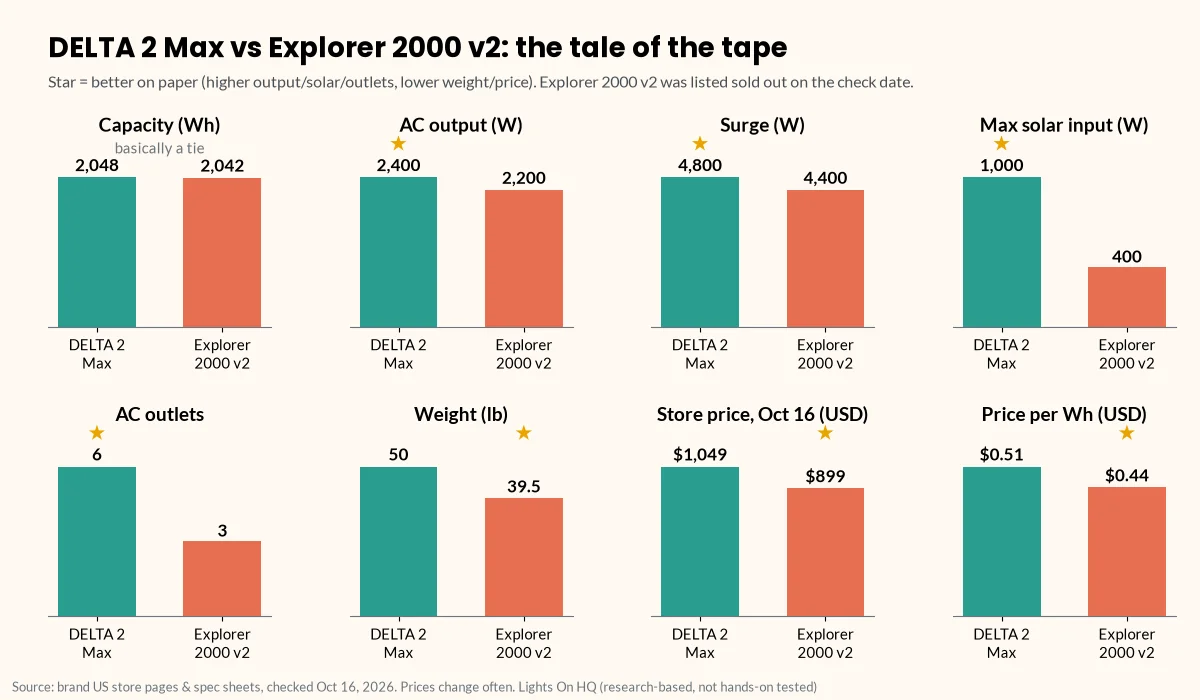
- Same-ish tank: 2,048 Wh (DELTA 2 Max) vs 2,042 Wh (Explorer 2000 v2).
- Pick the DELTA 2 Max for more solar (1,000 W vs 400 W), more AC outlets (6 vs 3), more output (2,400 W vs 2,200 W) and expansion batteries (up to 6,144 Wh).
- Pick the Explorer 2000 v2 for lighter weight (39.5 lb vs 50 lb), lower price per Wh, mostly wall charging, and a published <20 ms UPS switchover (the DELTA 2 Max spec table doesn’t list one).
- Heads up: the Explorer 2000 v2 showed “Sold Out” on Jackery’s US store on our check date.
It’s 7 p.m., a storm just knocked out the power, and the only things you truly care about are: the fridge (ice cream), the Wi-Fi (sanity) and a couple of lamps (so nobody steps on the cat). That’s exactly the job a 2 kWh power station is built for.
Both of these units store about 2 kWh: 2,048 Wh for the DELTA 2 Max and 2,042 Wh for the Explorer 2000 v2. That’s the size many people look at to keep a fridge, Wi-Fi and lights going through an outage. Past that, though, they’re built for different priorities. Think “expandable solar workhorse” vs “lighter, cheaper-per-Wh wall charger.”
Side-by-side specs
| Spec | EcoFlow DELTA 2 Max | Jackery Explorer 2000 v2 | Edge |
|---|---|---|---|
| Capacity | 2,048 Wh | 2,042 Wh | Tie |
| Battery chemistry | LFP (LiFePO4) | LFP (LiFePO4) | Tie |
| Rated cycles | 3,000 to 80% | 4,000 to 70% | Not directly comparable (why) |
| AC continuous output | 2,400 W (X-Boost 3,400 W) | 2,200 W | DELTA 2 Max |
| Surge | 4,800 W | 4,400 W | DELTA 2 Max |
| AC outlets | 6 | 3 (120 V, 18.3 A total) | DELTA 2 Max |
| Max solar input | 1,000 W (2 × 500 W, 11–60 V) | 400 W (2 × 8 mm DC) | DELTA 2 Max |
| Wall charging | 1,800 W “X-Stream” | ~1.75 h full charge (listed) | Similar on paper |
| UPS / switchover | Not listed in spec table | <20 ms | Explorer 2000 v2 (published figure) |
| Expansion batteries | Up to 2 (6,144 Wh total) | None listed in spec table | DELTA 2 Max |
| Weight | 50 lb (23 kg) | ~39.5 lb (17.9 kg) | Explorer 2000 v2 |
| Warranty | 5 years | 3 + 2 years (on Jackery.com) | Similar |
| Store price, Oct 16, 2026* | $1,049 (list $1,299) | $899 (list $999), sold out | Explorer 2000 v2 |
| Price per Wh* | ~$0.51 | ~$0.44 | Explorer 2000 v2 |
* Brand-store prices on our check date. Prices change often and aren’t live here. Confirm the current price at the retailer.
Check current DELTA 2 Max price at EcoFlow · Check Explorer 2000 v2 price and stock at Jackery
Where the DELTA 2 Max is stronger
Solar. Lots of it. 1,000 W of solar input is 2.5× the Explorer 2000 v2’s 400 W. In a multi-day outage, that gap adds up fast. On a good sun day, more input watts means more of the battery refilled before evening. Actual harvest depends on your panels, angle, weather and season (the sun does not take requests). Our solar charging calculator shows the math.
A growth path. EcoFlow says you can add up to two DELTA 2 Max Smart Extra Batteries, reaching 6,144 Wh (EcoFlow). Jackery’s spec table for the 2000 v2 lists no expansion port. If future-you might want more capacity, that matters. See expansion batteries explained.
More outlets, more headroom. Six AC outlets and 2,400 W continuous output (4,800 W surge) let you run more devices at once. Fewer “who unplugged the router?!” moments.
⚡ Quick take
If you’re planning for multi-day outages with solar, or you think you’ll want more capacity later, the DELTA 2 Max’s spec sheet is built for you.
Where the Explorer 2000 v2 is stronger
Weight. About 10.5 lb lighter. If you’ll haul it up and down stairs or out to a campsite, your lower back will notice.
Price per Wh. At the prices we saw, about $0.44 per Wh vs $0.51. It was out of stock, though, and EcoFlow runs frequent sales, so the gap can move either way.
A published UPS figure. Jackery lists switchover “under 20 ms,” for things like a router, computer or NAS. EcoFlow’s DELTA 2 Max spec table doesn’t give a switchover time. (EcoFlow’s newer DELTA 3 series lists <10 ms.) If seamless switchover is the main reason you’re buying, read the caveats below.
⚡ Quick take
If it’ll mostly sit by the wall outlet, get carried around, and keep a router or PC running through blips, the Explorer 2000 v2’s spec sheet leans your way. Just check that it’s back in stock.
About those cycle ratings (apples vs oranges)
- Jackery: “4,000 cycles to 70%+ capacity.”
- EcoFlow: “3,000 cycles to 80+% capacity.”
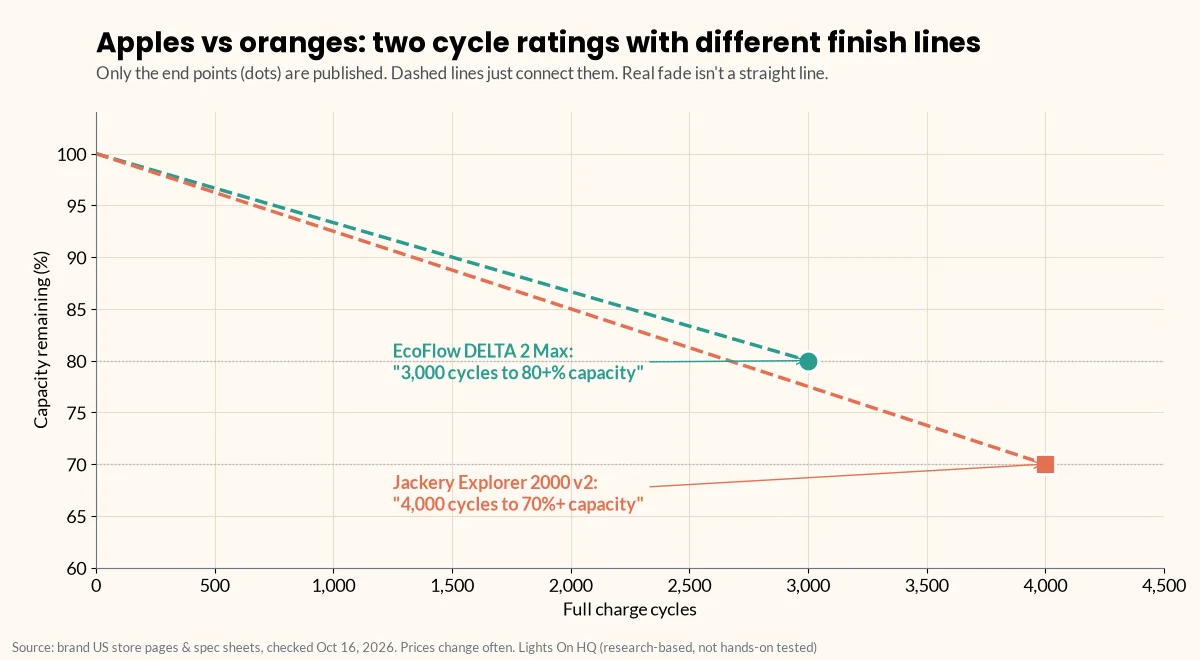
These use different finish lines, so you can’t simply say 4,000 beats 3,000. Either way, a home-backup unit that’s used a few dozen times a year will take many years to reach these numbers. For most buyers, solar, weight and outlets matter more.
Important caveats (the “please read this part” part)
⚠️ Safety notes
- “UPS” on power stations isn’t the same as an online UPS. A switchover of 10–20 ms keeps most routers and PCs running, but not everything. For CPAP or other medical equipment, confirm with your provider and the device maker before relying on any power station. CPAP sizing guide
- Connecting to house circuits: neither unit should be wired into your panel by a non-electrician. Use a licensed electrician and a proper transfer switch or inlet. Transfer switch explainer
- Fridge runtime depends on your fridge’s actual energy use, not its nameplate watts. Use the runtime calculator with your EnergyGuide label figure.
Other 2 kWh options worth a look
From our spec database (same check date):
- BLUETTI Elite 200 V2: 2,073.6 Wh, 2,600 W, 1,000 W solar, ≤15 ms UPS, 6,000+ cycles to 80%, 53.4 lb, $899.
- Anker SOLIX C2000 Gen 2: 2,048 Wh, 2,400 W (4,000 W peak), 800 W solar, 10 ms UPS, 41.7 lb, $999.99.
- DJI Power 2000: 2,048 Wh, 3,000 W, 10 ms UPS, 48.5 lb, $1,299. Solar up to 1,800 W needs DJI’s separate charger accessory.
See the full four-brand comparison
Related
Last checked: October 16, 2026. Spot an error? Let us know.