Disclosure: Lights On HQ is reader-supported. If you buy through links on this page we may earn a commission, at no extra cost to you. Full disclosure.
Research-based, not hands-on tested. Specs and prices come from official brand US product pages, checked October 16, 2026. Blank cells mean we could not confirm the number on an official page. Charge times are calculated estimates. See how we research.
⚡ Quick answer
- “Solar generator” is just marketing for power station + solar panels, sold together. Often cheaper than buying them separately.
- Best value starter: Jackery Explorer 1000 v2 + SolarSaga 200W, $719 on our check date ($898 bought separately).
- Best fast-charging mid-size: EcoFlow DELTA 3 Plus + 2 × 220W, $1,069 ($1,488 separately); the DELTA 3 Plus takes up to 1,000 W of solar.
- Big home backup: Jackery HomePower 3000 + 2 × SolarSaga 200W, $1,799, or EcoFlow DELTA Pro 3 + 400W, $3,099.
- Watch out: a bigger panel than the unit can accept doesn’t charge faster.
Buying a power station and panels separately is like buying a burger and fries separately. Totally allowed. Usually more expensive than the combo. Here are the combos.
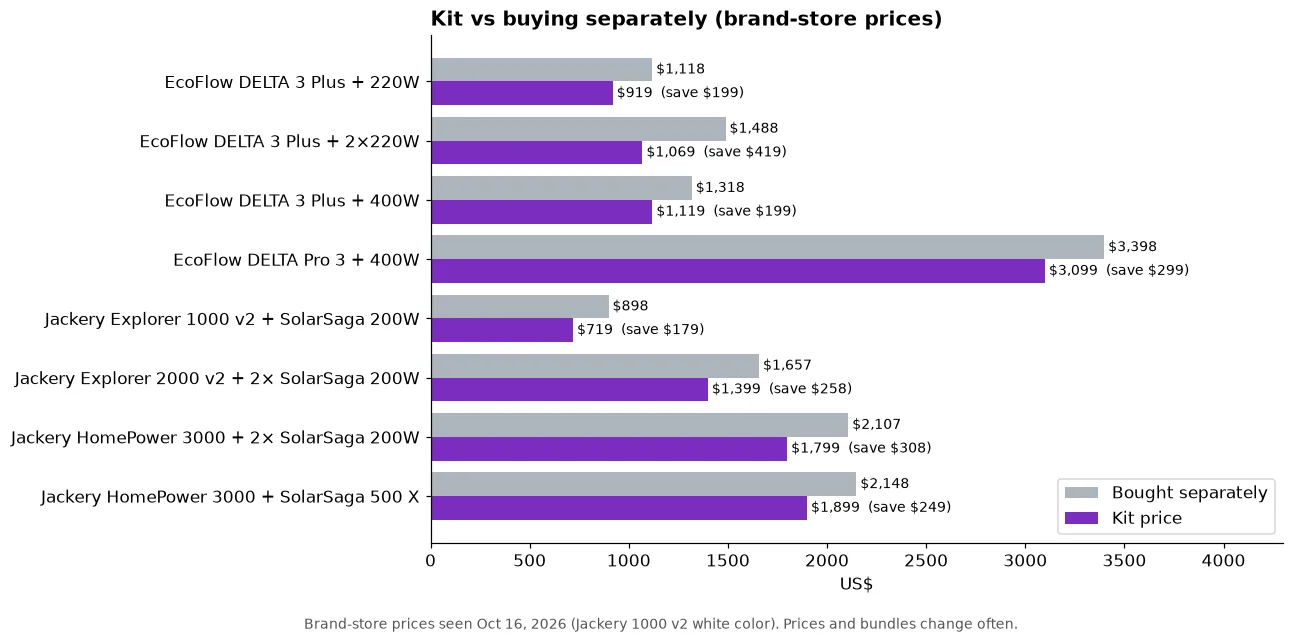
The kits at a glance
| Kit | Kit price | Separately | Battery | Panel watts vs unit’s max solar | Est. hours of strong sun, 0 to 100%* |
|---|---|---|---|---|---|
| Jackery Explorer 1000 v2 + SolarSaga 200W | $719 | $898 | 1,070 Wh | 200 W of 400 W | ~7.6 |
| EcoFlow DELTA 3 Plus + 220W | $919 | $1,118 | 1,024 Wh | 220 W of 1,000 W | ~6.6 |
| EcoFlow DELTA 3 Plus + 2 × 220W | $1,069 | $1,488 | 1,024 Wh | 440 W of 1,000 W | ~3.3 |
| EcoFlow DELTA 3 Plus + 400W | $1,119 | $1,318 | 1,024 Wh | 400 W of 1,000 W | ~3.7 |
| Jackery Explorer 2000 v2 + 2 × SolarSaga 200W | $1,399 | $1,657 | 2,042 Wh | 400 W of 400 W | ~7.3 |
| Jackery HomePower 3000 + 2 × SolarSaga 200W | $1,799 | $2,107 | 3,072 Wh | 400 W of 1,000 W | ~11.0 |
| Jackery HomePower 3000 + SolarSaga 500 X | $1,899 | $2,148 | 3,072 Wh | 500 W of 1,000 W | ~8.8 |
| EcoFlow DELTA Pro 3 + 400W | $3,099 | $3,398 | 4,096 Wh | 400 W of 2,600 W | ~14.6 |
*Hours ≈ Wh ÷ (panel watts, capped at the unit’s max, × 0.7). The 0.7 is our planning factor for real-world losses. At ~5 strong-sun hours a day, divide by 5 to get days. “Separately” = standalone station price + standalone panel price on each brand’s store, Oct 16, 2026 (Jackery 1000 v2 in Dune White; the black version was $20 cheaper). One oddity: EcoFlow’s DELTA 3 Plus kit page showed a “compare at” price below the sale price; we used the listed sale price.
Our picks
Best starter: Jackery Explorer 1000 v2 + SolarSaga 200W
At 23.8 lb, the Explorer 1000 v2 is the lightest ~1 kWh unit in our database, and the kit saves about $179. One 200W panel only uses half of the 400 W solar input, so budget for a second panel if you want faster refills.
Best mid-size: EcoFlow DELTA 3 Plus + 2 × 220W
The DELTA 3 Plus takes up to 1,000 W of solar over two 500 W ports, so it has lots of room to grow. Two 220W bifacial panels make for a fast, roughly half-day recharge on a good day (estimate).
Best for big home backup: Jackery HomePower 3000 kits
3,072 Wh with 1,000 W of solar input. The 2 × 200W kit is the better deal, while the 500 X kit uses one big panel instead of two. Either way you’re using half the input or less, so there’s room to add panels later.
Go big: EcoFlow DELTA Pro 3 + 400W
4,096 Wh and a whopping 2,600 W of solar input. One 400W panel barely scratches that input, so think of it as a starter panel.
The match-up trap (Jackery Explorer 2000 v2 + 500W)
Jackery also sells the Explorer 2000 v2 with a “SolarSaga 500W” option ($1,499). Since the 2000 v2’s solar input caps at 400 W, a 500W panel won’t charge it any faster than 400 W. It can help on hazy days, but don’t pay extra expecting speed.
What about BLUETTI and Anker SOLIX kits?
Both brands sell bundles too. Anker SOLIX lists combos like C1000 + PS400 and C2000 Gen 2 with 400W panels, and BLUETTI sells its own solar generator bundles. We couldn’t confirm stable bundle prices on their official stores on our check date, so they’re not in the table. To build your own, see the panel lists in our panel pairing guide.
⚠️ Safety, the short version
- Stay inside your power station’s solar voltage and current limits. Over-voltage can damage it, and warranty terms may not cover it.
- Portable panels charging a portable power station is plug-and-play. Wiring solar or batteries into your home electrical system needs a licensed electrician, permits and a proper transfer switch or inlet.
- Never plug a power station into a wall outlet to power the house (backfeeding). It can kill utility workers.
Bottom line
A kit is usually the cheapest way in, as long as the panels fit the unit’s solar limits. Plug any combo into the Solar Charge Time Calculator, check daily needs with the runtime calculator, and compare units in the spec database.