Disclosure: Lights On HQ is reader-supported. If you buy through links on this page we may earn a commission, at no extra cost to you. Full disclosure.
Research-based, not hands-on tested. Specs and prices come from official brand US product pages, checked October 16, 2026. Blank cells mean we could not confirm the number on an official page. Charge times are calculated estimates. See how we research.
⚡ Quick answer
- Easiest path: buy the same brand’s panels. Connectors match and the brand has already checked the voltages.
- Three numbers to match: your unit’s max solar watts, its voltage window, and its max amps.
- Plug types: EcoFlow and Anker SOLIX use XT60/XT60i inputs, Jackery uses DC8020 ports, and BLUETTI panels ship with MC4 leads plus adapters.
- Want the generic how-to first? Read our solar pairing basics.
Panels and power stations are like phone chargers: almost everything looks like it should fit, but the right match charges fast and the wrong one does nothing (or worse). Here’s a brand-by-brand cheat sheet.
The series-wiring sanity check
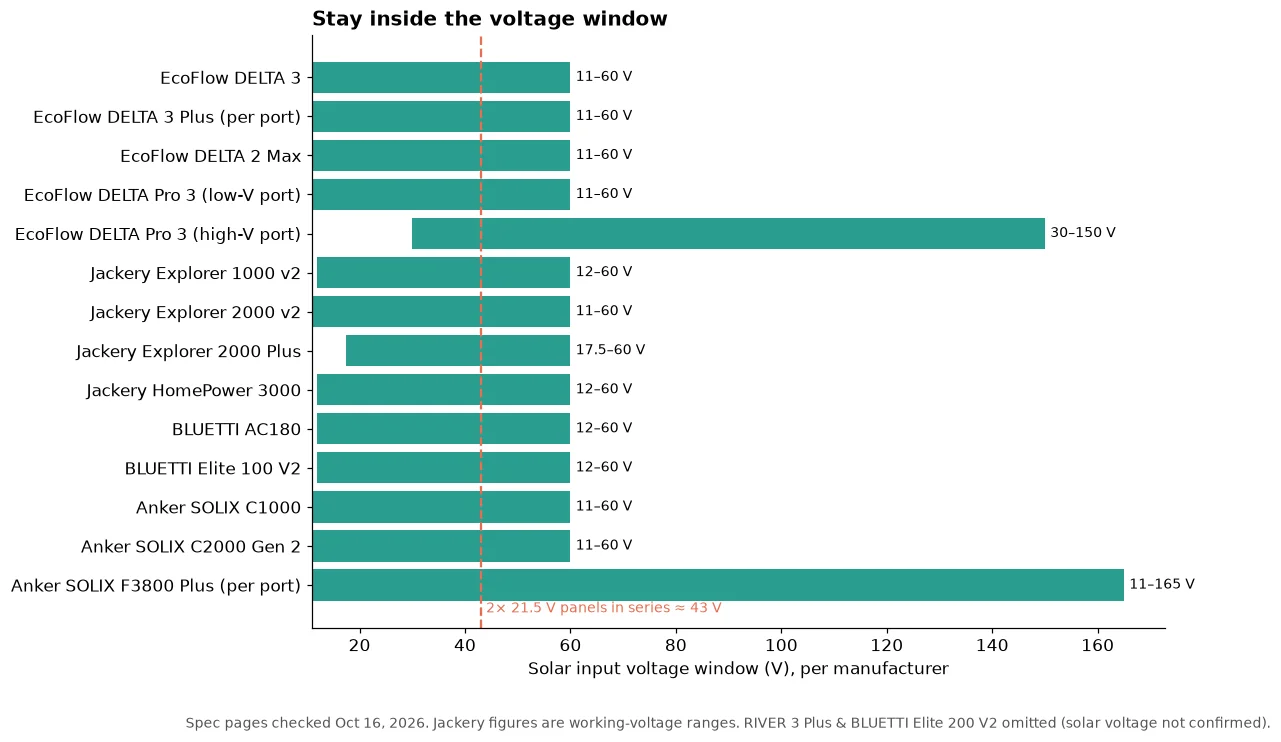
Panels in series add their voltages. Two EcoFlow NextGen 220W panels (21.5 V open-circuit each, per EcoFlow) come to about 43 V. That’s safely inside an 11 to 60 V window. Three would be about 64.5 V, which is over 60 V. Open-circuit voltage also rises in cold weather, so leave some headroom.
EcoFlow
| Power station | Max solar | Voltage / current (per EcoFlow) |
|---|---|---|
| RIVER 3 Plus | 220 W | |
| DELTA 3 | 500 W | 11 to 60 V |
| DELTA 3 Plus | 1,000 W (2 × 500 W ports) | 11 to 60 V per port |
| DELTA 2 Max | 1,000 W (500 W per port) | 11 to 60 V, 15 A |
| DELTA Pro 3 | 2,600 W | High-V port 30 to 150 V, 15 A, 1,600 W; low-V port 11 to 60 V, 20 A, 1,000 W |
Official EcoFlow panels (connector: XT60/XT60i input cable):
| Panel | Price (Oct 16) | Open-circuit voltage |
|---|---|---|
| 100W Rigid | $139 | 20.3 V |
| NextGen 220W Bifacial | $399 | 21.5 V |
| 400W Portable | $599 |
Match-ups: a single 220W panel suits the RIVER 3 Plus (its 220 W cap) or a DELTA 3. One 400W panel per port is a nice fit on a DELTA 3 Plus or DELTA 2 Max (each port caps at 500 W). On the RIVER 3 Plus our database’s notes didn’t confirm a solar voltage window, so check the manual first.
Jackery
| Power station | Max solar | Working voltage / current (per Jackery) |
|---|---|---|
| Explorer 1000 v2 | 400 W | 2 × DC8020: 12 to 16 V at 8 A; 16 to 60 V at 10.5 A (21 A / 400 W combined) |
| Explorer 2000 v2 | 400 W | 11 to 16 V at 8 A; 16 to 60 V at 12 A (21 A / 400 W combined) |
| Explorer 2000 Plus | 1,400 W | 17.5 to 60 V at 12 A per port (24 A / 1,400 W combined) |
| HomePower 3000 | 1,000 W | 12 to 16 V at 8 A; 16 to 60 V at 12 A (24 A / 1,000 W combined) |
Official Jackery panels (connector: DC8020; some models need a DC8020-to-DC7909 adapter, which Jackery includes with certain panels):
| Panel | Price (Oct 16) | Open-circuit voltage |
|---|---|---|
| SolarSaga 100 Prime | $199 | |
| SolarSaga 200W | $379 | 22 V |
| SolarSaga 500 X | $799 |
Match-ups: the Explorer 1000 v2 and 2000 v2 both cap at 400 W, so two SolarSaga 200W panels max them out. A 500 X on those units won’t charge faster than 400 W. The HomePower 3000 (1,000 W) and Explorer 2000 Plus (1,400 W) are where the 500 X makes sense.
BLUETTI
| Power station | Max solar | Voltage / current (per BLUETTI) |
|---|---|---|
| AC180 | 500 W | 12 to 60 V open-circuit, 10 A |
| Elite 100 V2 | 1,000 W | 12 to 60 V, 20 A |
| Elite 200 V2 | 1,000 W |
Official BLUETTI panels (MC4 leads; BLUETTI lists MC4 and Anderson/XT60 adapters by model):
| Panel | Price (Oct 16) | Open-circuit voltage |
|---|---|---|
| SP100L 100W | $249 | 24.62 V |
| 200W Portable | $399 | 24.6 V |
| 350W | $649 | 44 V |
| 500W (SORA 500) | $849 | 49.1 V |
Match-ups: an AC180 tops out at 500 W and 60 V. One 350W panel (44 V) fits; two 350W panels in series (about 88 V) would not. Two 200W panels in series come to about 49 V, which fits. On an Elite 100 V2, two 200W panels in series plus the 20 A limit leave lots of room; check BLUETTI’s manual for parallel setups.
Anker SOLIX
| Power station | Max solar | Voltage / current (per Anker) |
|---|---|---|
| C1000 | 600 W | 11 to 60 V, 12.5 A (XT-60) |
| C2000 Gen 2 | 800 W | 11 to 60 V, 17 A (XT-60i) |
| F3800 Plus | 3,200 W (2 × 1,600 W) | 11 to 165 V, 17 A per input |
Official Anker SOLIX panels (XT-60i connector):
| Panel | Price shown (Oct 16) | Open-circuit voltage |
|---|---|---|
| PS100 Bifacial | $249.99 | |
| PS200 Bifacial | $499.99 | |
| PS400 Bifacial | $699.99 |
Match-ups: a PS400 is a natural single-panel match for the C1000 (600 W cap) or C2000 Gen 2 (800 W cap; two PS400s max it on paper). The F3800 Plus’s wide 11 to 165 V window allows longer series strings, but follow Anker’s manual for exact configurations.
⚠️ Safety, the short version
- Stay inside your power station’s solar voltage and current limits. Over-voltage can damage it, and warranty terms may not cover it.
- Portable panels charging a portable power station is plug-and-play. Wiring solar or batteries into your home electrical system needs a licensed electrician, permits and a proper transfer switch or inlet.
- Never plug a power station into a wall outlet to power the house (backfeeding). It can kill utility workers.
Bottom line
Same brand = least drama. Third-party = check watts, volts, amps and the plug. For charge-time math, try our Solar Charge Time Calculator, read how long it takes to charge with solar, or see bundled deals in best solar generator kits. All base specs live in the spec database.