Disclosure: Lights On HQ is reader-supported. If you buy through links on this page we may earn a commission, at no extra cost to you. Full disclosure.
Research-based, not hands-on tested. Specs come from manufacturer US product pages, checked October 16, 2026 (see our spec database). Runtimes are calculated estimates. See how we research.
⚡ Quick answer
- Check 3 limits on your power station: max solar watts, the allowed voltage range, and max amps. All three are in the manual or spec page.
- Match panel watts to the watt limit. Extra panel watts above the limit don’t charge faster (the unit caps it), though a little extra helps on cloudy days if voltage stays in range.
- Rough charge time: battery Wh ÷ (panel watts × ~0.7) ≈ hours of good sun. Real life varies a lot with weather, angle and season.
- Biggest mistake: wiring too many panels in series and going over the voltage limit.
Solar is where a power station goes from “nice battery” to “tiny power plant.” The sun shows up for free every morning, and with the right panels, so does your power. Let’s get your pairing right the first time.
The three numbers that matter
Think of it like a garden hose:
- Watts = how much water flows. Your power station has a maximum solar input in watts.
- Volts = water pressure. Too much pressure bursts the hose. Every unit has a solar voltage range, and exceeding the top end can damage it.
- Amps = the width of the hose. There’s a current limit too.
Panels wired in series add their voltages. Panels wired in parallel add their amps. Your unit’s manual tells you which combos are allowed.
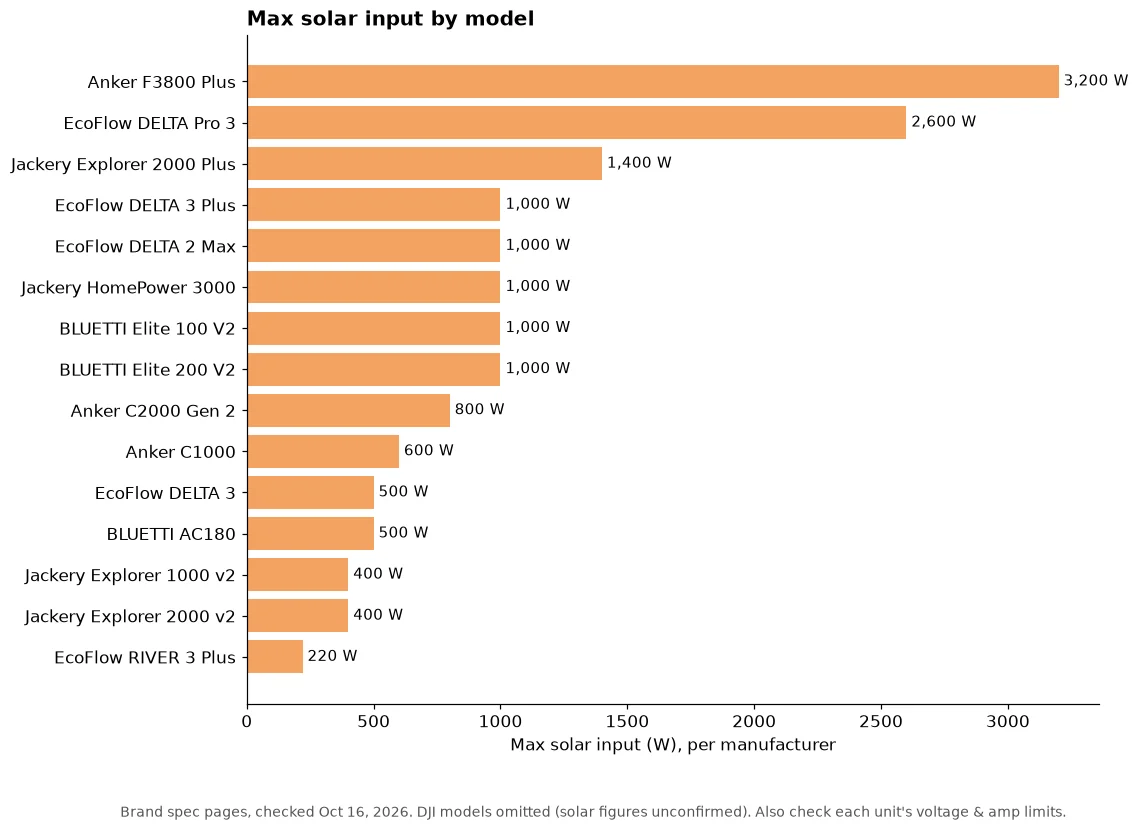
Max solar input by model (watts)
| Model | Capacity | Max solar input | Rough “good sun” hours at max input* |
|---|---|---|---|
| Anker SOLIX F3800 Plus | 3,840 Wh | 3,200 W | ~1.7 |
| EcoFlow DELTA Pro 3 | 4,096 Wh | 2,600 W | ~2.3 |
| Jackery Explorer 2000 Plus | 2,042.8 Wh | 1,400 W | ~2.1 |
| EcoFlow DELTA 3 Plus | 1,024 Wh | 1,000 W | ~1.5 |
| EcoFlow DELTA 2 Max | 2,048 Wh | 1,000 W | ~2.9 |
| Jackery HomePower 3000 | 3,072 Wh | 1,000 W | ~4.4 |
| BLUETTI Elite 100 V2 | 1,024 Wh | 1,000 W | ~1.5 |
| BLUETTI Elite 200 V2 | 2,073.6 Wh | 1,000 W | ~3.0 |
| Anker SOLIX C2000 Gen 2 | 2,048 Wh | 800 W | ~3.7 |
| Anker SOLIX C1000 | 1,056 Wh | 600 W | ~2.5 |
| EcoFlow DELTA 3 | 1,024 Wh | 500 W | ~2.9 |
| BLUETTI AC180 | 1,152 Wh | 500 W | ~3.3 |
| Jackery Explorer 1000 v2 | 1,070 Wh | 400 W | ~3.8 |
| Jackery Explorer 2000 v2 | 2,042 Wh | 400 W | ~7.3 |
| EcoFlow RIVER 3 Plus | 286 Wh | 220 W | ~1.9 |
*Very rough: capacity ÷ (max input × 0.7), assuming you own enough panels to hit the max and the sun cooperates. Panels rarely deliver their full rated watts; heat, angle, clouds and shade all cut output. Our 0.7 factor is a planning assumption, not a measurement. DJI models are left out because their solar figures in our database aren’t confirmed.
How many panel watts should you buy?
- Weekend camper: 100 to 200 W of portable panels keeps phones, lights and a fan going on a small or ~1 kWh unit.
- Outage backup: aim for 400 W or more on a ~1 to 2 kWh unit so a sunny day can make a real dent in your fridge’s daily use. See how long a power station runs a fridge.
- Off-grid-ish: max out your unit’s input. That’s where the 1,000 W+ models shine.
Same-brand or third-party panels?
Same-brand panels are the “it just works” option: matching connectors, known voltages. Third-party panels can save money, but you must check open-circuit voltage (Voc), connector type and whether you need an adapter. When in doubt, follow the power station manual’s solar section to the letter.
Common oopsies
- Too many panels in series → voltage over the limit. Check Voc, and remember Voc rises in cold weather.
- Shading one panel → in series, it can drag down the whole string.
- Laying panels flat → tilting toward the sun usually helps a lot.
- Panels behind a window → glass cuts output. Put them outside.
⚠️ Quick safety note
Portable solar charging a power station is plug-and-play. Wiring solar or batteries into your home’s electrical system is not: that needs a licensed electrician, permits and a proper transfer switch or inlet. Never backfeed through a wall outlet.
Bottom line
Match the watts, respect the volts, don’t forget the amps. Then let the sun do the work. Compare every unit’s solar input in the spec database and size your daily needs with the runtime calculator.
☀️ More solar guides: best solar panels for each power station, best solar generator kits, how long to charge with solar and the Solar Charge Time Calculator.