
Disclosure: Lights On HQ is reader-supported. If you buy through links on this page we may earn a commission, at no extra cost to you. Full disclosure.
Research-based guide. This page shows the math with example numbers. It doesn’t report hands-on testing. Manufacturer formulas and specs were checked October 16, 2026. See our methodology.
📝 TL;DR
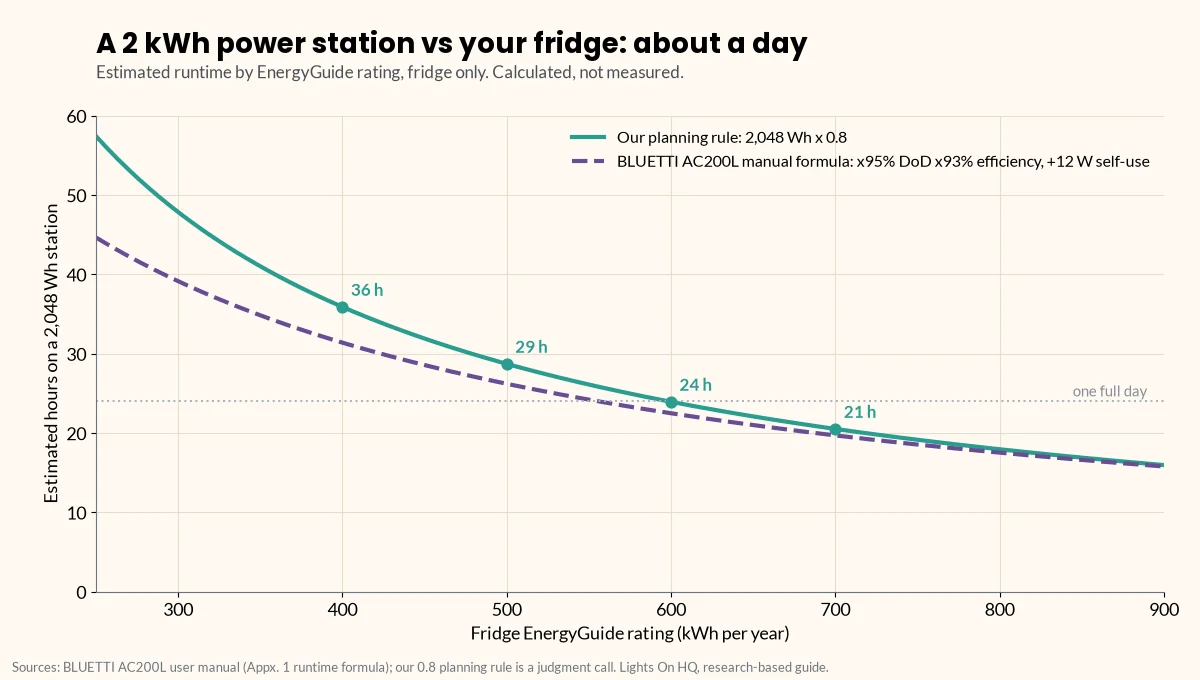
- Short answer: a ~2,000 Wh (2,048 Wh) power station runs a fridge rated 400–700 kWh/year for roughly 20–36 hours, using our planning rule (usable ≈ 80% of rated).
- The formula: hours ≈ (rated Wh × 0.8) ÷ (fridge’s kWh per year ÷ 8.76).
- Example: a 500 kWh/yr fridge averages about 57 W, so 2,048 Wh lasts about 29 hours (or about 26 hours using BLUETTI’s AC200L manual formula with self-consumption).
- Shorter in real life if: the kitchen is hot, the door keeps opening, the battery is cold, or other things are plugged in.
You bought (or are eyeing) a 2 kWh power station. The storm forecast looks spicy. And there’s one question rattling around your brain at 2 a.m.: will the ice cream make it?
Good news: this is just arithmetic, and you only need one number from your fridge. Let’s do it.
The one number you need: kWh per year
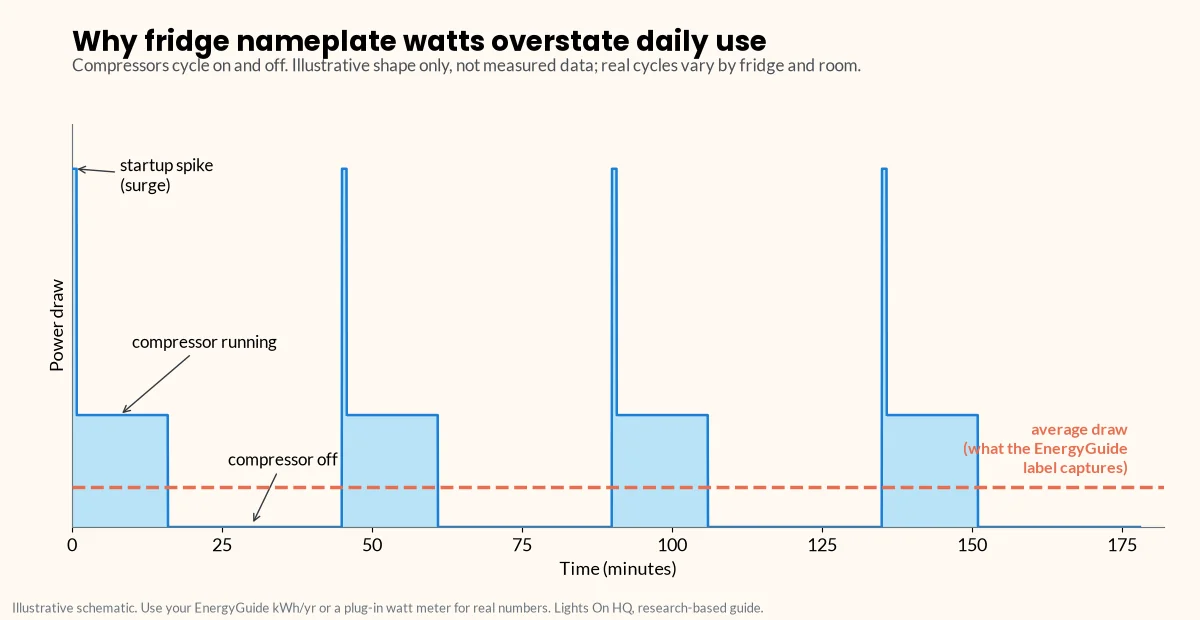
Find the yellow EnergyGuide label on your fridge (or the spec sheet for your model) and look for kWh per year. That’s the fridge’s estimated annual energy use, and it already accounts for the compressor cycling on and off.
Why not use the watts on the nameplate? Because a fridge doesn’t run its compressor constantly. It cycles: on for a while, off for a while. The nameplate tells you how hard it pulls when it’s on, not how much energy it uses over a day.
Convert the label number:
- Daily Wh = kWh per year ÷ 365 × 1,000
- Average watts = daily Wh ÷ 24 (or simply kWh per year ÷ 8.76)
Example: 500 kWh/yr → about 1,370 Wh/day → about 57 W average.
Two ways to estimate runtime
Method 1: Our planning rule (simple)
A power station can’t deliver all of its rated capacity at the AC outlet. Inverter losses and depth of discharge eat some of it. Our rule of thumb (a judgment call, not a manufacturer spec):
Usable Wh ≈ rated Wh × 0.8
So for a 2,048 Wh unit: about 1,640 usable Wh.
Hours ≈ 1,640 ÷ average fridge watts. For the 500 kWh/yr fridge: 1,640 ÷ 57 ≈ 29 hours.
Method 2: A manufacturer’s own formula (more detailed)
BLUETTI’s AC200L user manual gives this formula (manual PDF):
Operation time = capacity × DoD × η ÷ (load + self-consumption)
…with 95% depth of discharge, inverter efficiency “typically over 93%” and about 12 W of self-consumption for the AC200L. BLUETTI’s own example: a 40 W fridge runs about 34.7 hours (2,048 × 95% × 93% ÷ 52 W).
For our 500 kWh/yr fridge (57 W average): 2,048 × 0.95 × 0.93 ÷ (57 + 12) ≈ 26 hours.
Notice that self-consumption matters for small loads like a fridge: those 12 W are a real chunk of a 57 W average. Other models have different efficiencies and idle draw; BLUETTI’s Elite 200 V2 manual, for example, uses 90% DoD, inverter efficiency over 85% and about 10 W self-consumption (manual PDF).
⚡ Quick take
Both methods land in the same neighborhood: about a day for a typical fridge on 2 kWh. If you need certainty, use the watt meter and the more conservative number.
The cheat sheet: 2,048 Wh vs EnergyGuide ratings
These are calculated, not measured. Your fridge, room temperature and habits will change the result.
| EnergyGuide rating | Avg. watts | Wh per day | Hours (0.8 rule) | Hours (AC200L manual formula) |
|---|---|---|---|---|
| 300 kWh/yr | 34 W | 822 | ~48 h | ~39 h |
| 400 kWh/yr | 46 W | 1,096 | ~36 h | ~31 h |
| 500 kWh/yr | 57 W | 1,370 | ~29 h | ~26 h |
| 600 kWh/yr | 68 W | 1,644 | ~24 h | ~22 h |
| 700 kWh/yr | 80 W | 1,918 | ~21 h | ~20 h |
| 800 kWh/yr | 91 W | 2,192 | ~18 h | ~18 h |
What makes the real number shorter
- Heat and door openings. A fridge in a hot kitchen, or one that gets opened every 20 minutes, works harder than its label assumes.
- Cold batteries. BLUETTI’s manual notes that low temperatures and excessive loads can significantly reduce capacity and runtime.
- Sharing the battery. Router, lights, phones: every extra watt comes out of the fridge’s share. Use the load-list method to plan the whole list.
- The startup spike. Not a runtime issue, but a “will it start at all” issue. Your station’s surge rating must cover the compressor’s startup draw. See surge vs running watts.
How to stretch it
- Keep the doors closed. FoodSafety.gov says a closed fridge keeps food safe for up to 4 hours with no power at all, and a full freezer about 48 hours (24 if half full) (FoodSafety.gov).
- Add solar. Even a few hundred watts of sun can cover a fridge’s daytime use. Solar charging calculator
- Go expandable. Units like the EcoFlow DELTA 2 Max (to 6,144 Wh) or BLUETTI AC200L (to 8,192 Wh) can add battery later (EcoFlow, BLUETTI).
⚠️ Safety notes
- Plug the fridge directly into the power station. Never connect a power station to a wall outlet or home wiring (“backfeeding”); the CPSC warns it endangers utility workers and neighbors (CPSC, PDF). Hard-wired circuits need a licensed electrician and a transfer switch or inlet.
- Battery math doesn’t overrule food safety. If food sat above 40°F for more than 2 hours, follow FoodSafety.gov’s chart.
Ready to pick a unit? See best power station to run a refrigerator.
Related
- Power station runtime calculator
- What size power station do I need?
- Best power station for a refrigerator
- Sizing & runtime guides (hub)
Last checked: October 16, 2026. Found a mistake in the math? Tell us.