Disclosure: Lights On HQ is reader-supported. If you buy through links on this page we may earn a commission, at no extra cost to you. Full disclosure.
Research-based, not hands-on tested. Specs come from manufacturer US product pages, checked October 16, 2026 (see our spec database). Runtimes are calculated estimates. See how we research.
⚡ Quick answer
- Pick a power station if you want indoor-safe, silent, low-maintenance power for essentials: fridge, CPAP, Wi-Fi, lights, phones. Best for short and medium outages, apartments and camping.
- Pick a gas generator if you need to run big loads for days (well pump, central AC, electric range) and you’re fine with fuel storage, noise and outdoor-only use.
- Can’t decide? Lots of people use both: battery inside for quiet nights, generator outside to recharge during the day.
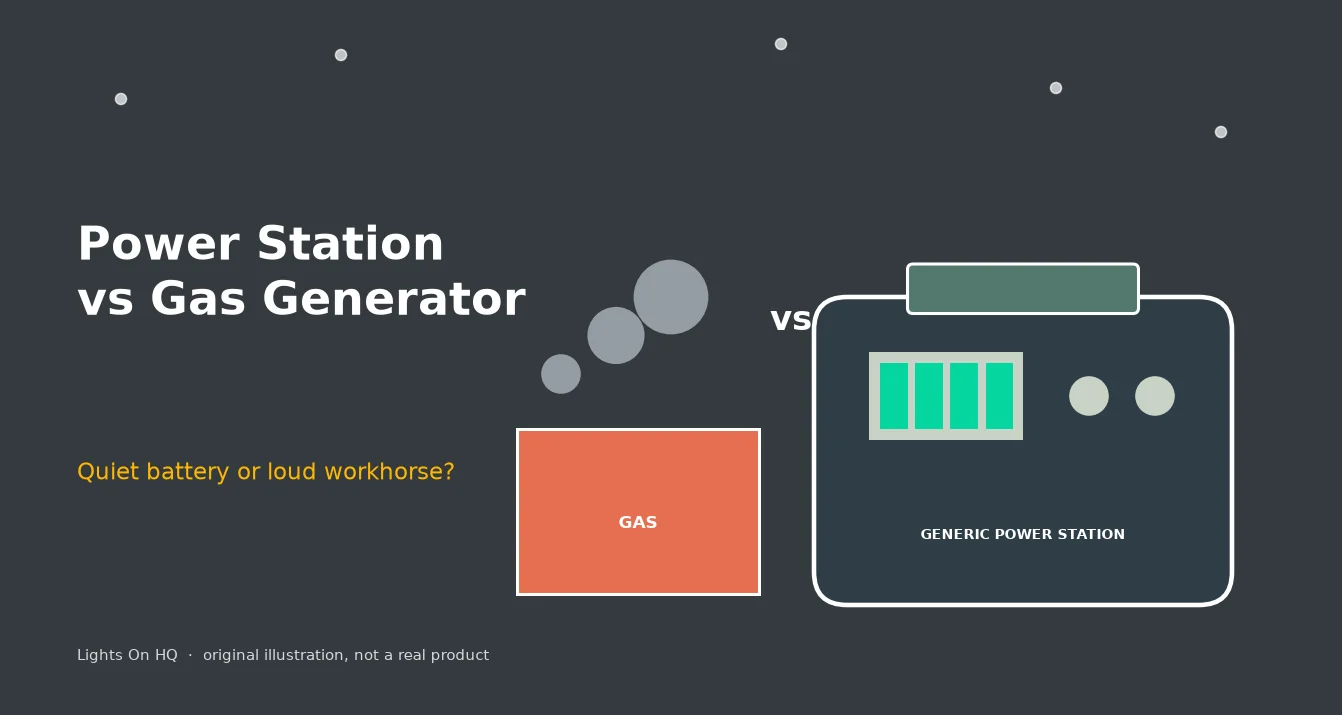
It’s the classic outage showdown. In one corner: the quiet, polite battery that lives in your closet. In the other: the loud, gas-guzzling workhorse that can run forever (as long as you keep feeding it). Who wins? Depends entirely on what you need to power and for how long.
Round 1: Safety
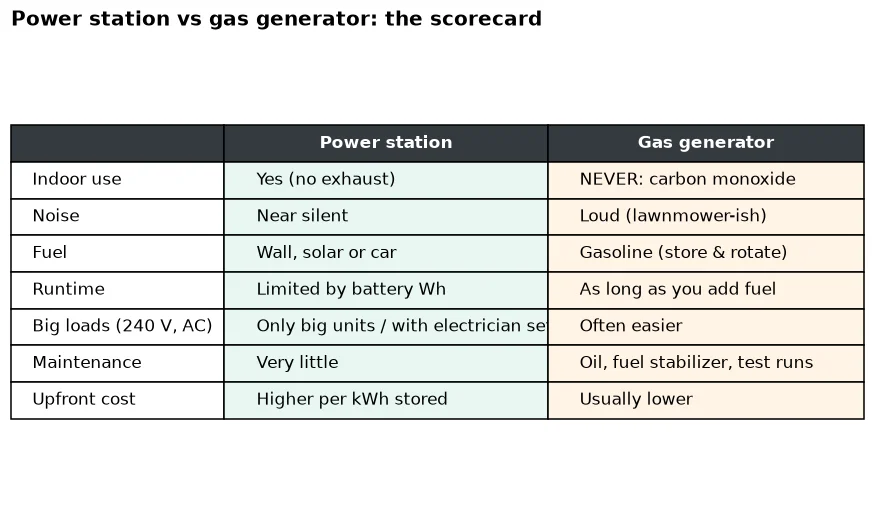
Power station wins, easily. No exhaust, so you can use it indoors (with normal ventilation and away from water). Gas generators produce carbon monoxide, an odorless gas that can kill. The CDC says to run generators outside, at least 20 feet from doors and windows, never in a garage, basement or porch, and to install CO alarms.
Round 2: Noise
Power station. Batteries are near silent; at most you’ll hear a cooling fan. Generators are loud enough that some campgrounds restrict their hours.
Round 3: Runtime
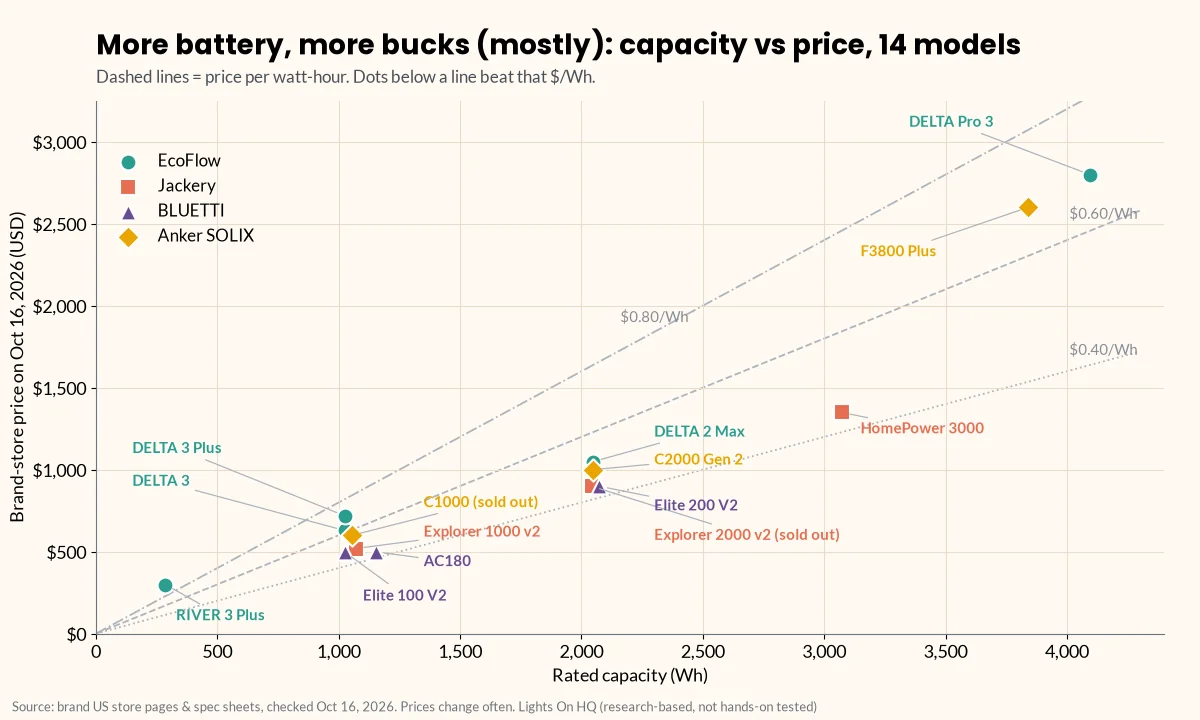
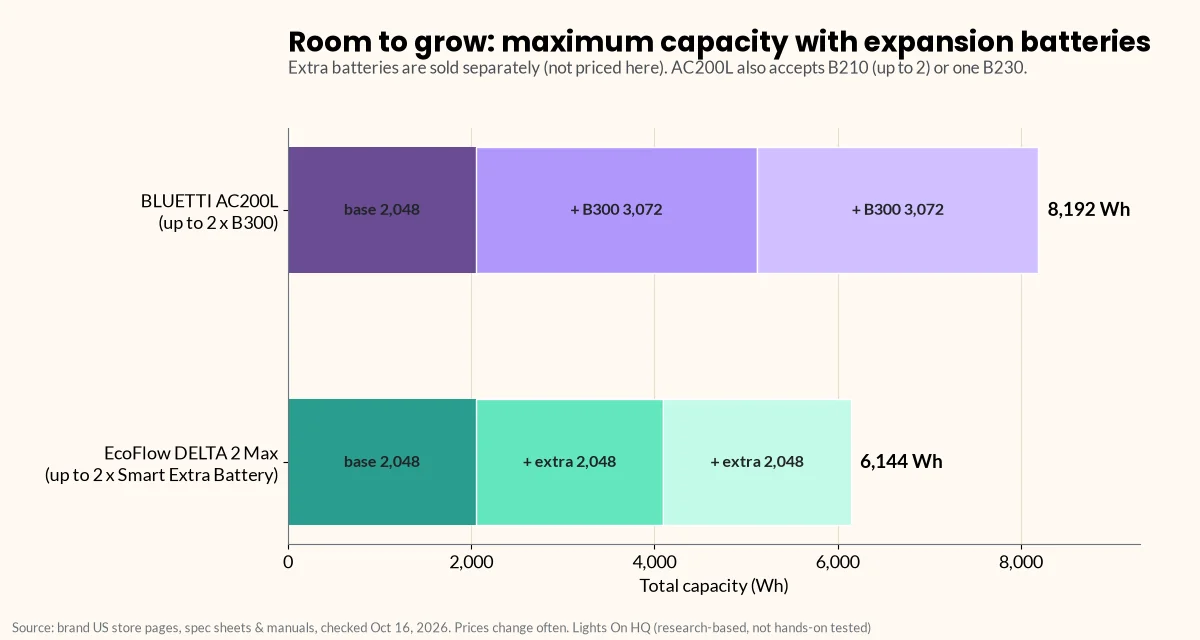
Generator. A power station holds a fixed amount of energy: 1,024 Wh for an EcoFlow DELTA 3, 2,048 Wh for an Anker SOLIX C2000 Gen 2, 3,072 Wh for a Jackery HomePower 3000. When it’s empty, you need the grid, solar or a car to refill. A generator runs as long as you have fuel (and can safely refuel).
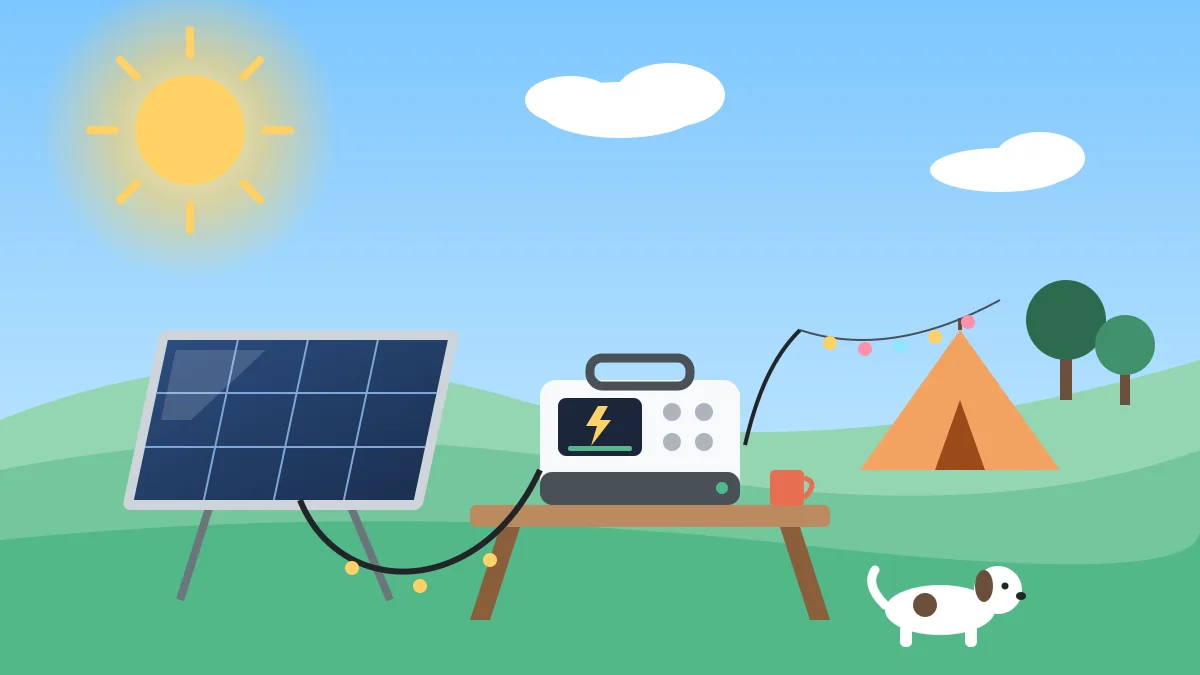
Solar narrows the gap: units that take 1,000 W or more of solar can refill a lot on a sunny day. See the solar pairing guide.
Round 4: Big loads
Usually generator, with an asterisk. Large power stations are catching up: the Anker SOLIX F3800 Plus lists 6,000 W of AC output and the EcoFlow DELTA Pro 3 lists 4,000 W. But energy is still finite, and 240 V whole-house use requires an electrician-installed transfer switch or inlet either way.
Round 5: Maintenance and storage
Power station. Charge it every few months and you’re mostly done. Generators need oil changes, fuel stabilizer, regular test runs, and a safe place to store gasoline (which goes stale).
Round 6: Upfront cost
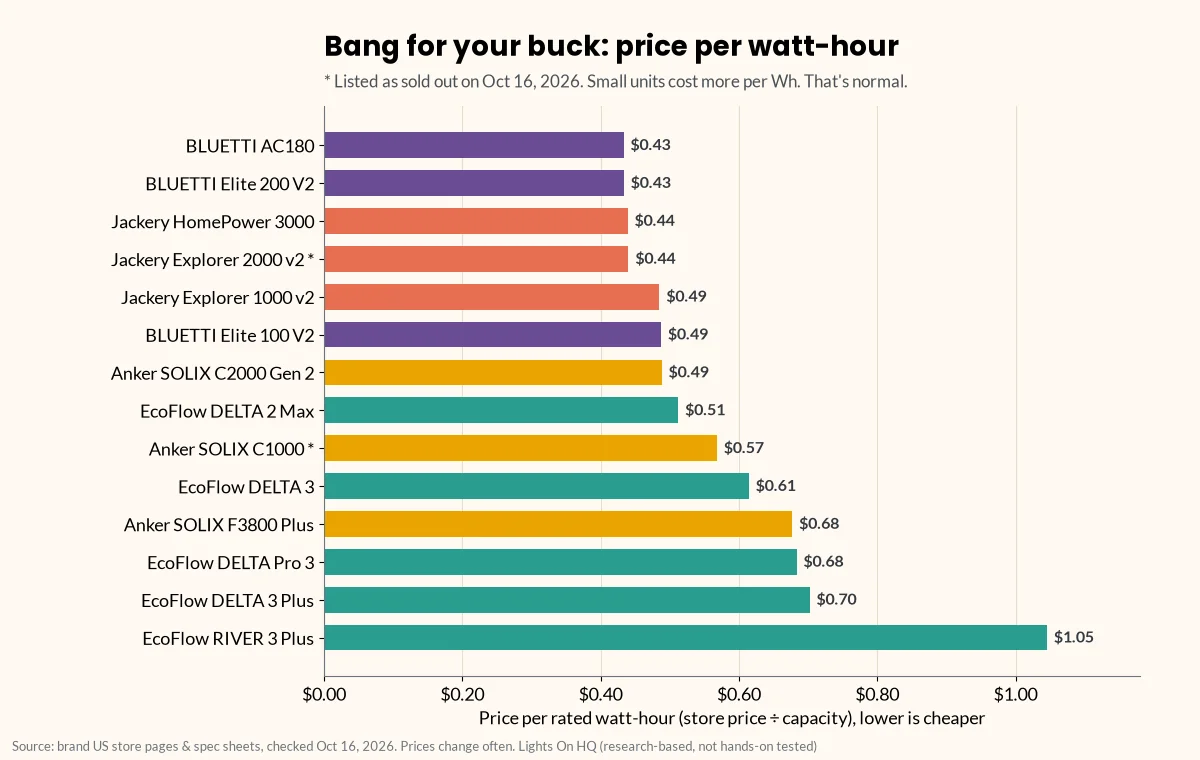
Usually generator. Per unit of energy, batteries cost more upfront. On our Oct 16, 2026 price check, LiFePO4 units ranged from about $0.43 to $1.05 per Wh of capacity. See price per Wh for 17 models. A battery has no fuel cost, though, and solar recharging is free.
The scorecard
| Category | Winner |
|---|---|
| Indoor safety | Power station |
| Noise | Power station |
| Runtime for days | Gas generator |
| Huge loads | Gas generator (big batteries closing in) |
| Maintenance | Power station |
| Upfront cost | Gas generator |
| Apartment-friendly | Power station |
Who should buy what
- Apartment or condo dweller: power station, no contest. Start with what size do I need.
- CPAP user: power station; see our CPAP guide.
- Rural home with a well pump and long outages: a generator (or a very large battery system) with a transfer switch installed by a licensed electrician.
- Camper: power station for quiet campsites; see best power station for camping.
⚠️ Two rules that apply to both
- Never backfeed. Don’t plug a generator or power station into a wall outlet to power your house. It can kill utility workers and damage equipment. Use an electrician-installed transfer switch or inlet.
- Generators outdoors only, far from windows and doors, with CO alarms inside.
Bottom line
For most households riding out a typical outage, a power station handles the essentials safely and silently. For multi-day, whole-house needs, a generator (or a hybrid) still earns its spot. Browse the best power stations for home backup, or see how you’d fare in our Blackout Survival Challenge.