Disclosure: Lights On HQ is reader-supported. If you buy through links on this page we may earn a commission, at no extra cost to you. This doesn’t change which products we include or how we rank them. Read our full disclosure.
Research-based, not hands-on tested. We haven’t tested these units ourselves. Specs and prices come from each manufacturer’s US product page or user manual, checked October 16, 2026, and linked below. See our methodology.
📝 TL;DR
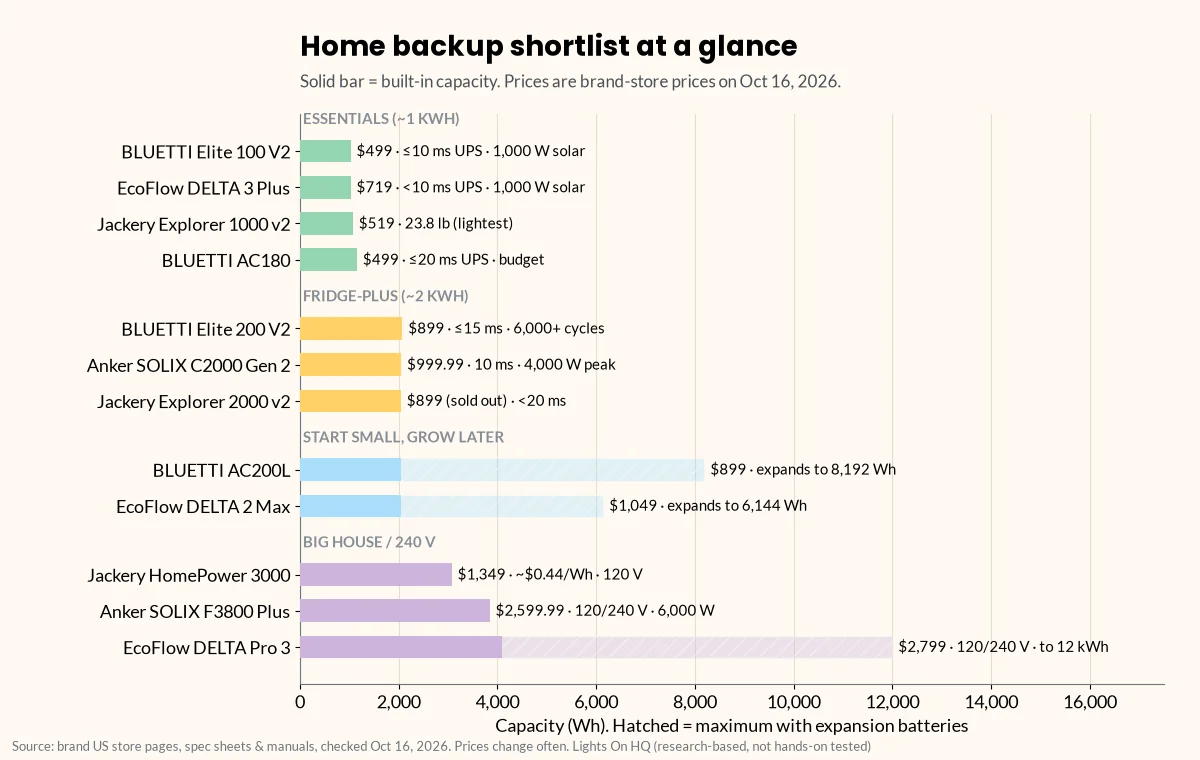
- Just the essentials (Wi-Fi, phones, lights, a laptop): a ~1 kWh unit. Our spec pick: BLUETTI Elite 100 V2 ($499, ≤10 ms UPS, 1,000 W solar, 25.3 lb).
- Fridge plus essentials: a ~2 kWh unit. Spec pick: BLUETTI Elite 200 V2 ($899, 2,073.6 Wh, ≤15 ms UPS, 6,000+ cycles to 80%). Want a published motor-surge figure? Look at the Anker SOLIX C2000 Gen 2 ($999.99, 4,000 W peak, 10 ms UPS).
- Start small, grow later: BLUETTI AC200L (2,048 Wh, expandable to 8,192 Wh, $899) or EcoFlow DELTA 2 Max (expandable to 6,144 Wh, $1,049).
- Big loads or 240 V (well pump, some central AC): EcoFlow DELTA Pro 3 or Anker SOLIX F3800 Plus, installed with a licensed electrician and a proper transfer switch or inlet.
- Best value 3 kWh on our check date: Jackery HomePower 3000 ($1,349, about $0.44 per Wh).
It’s 9:47 p.m. The wind has been showing off all evening, and then click: the house goes dark, the fridge goes quiet, and the router’s little lights fade like a sad birthday cake. Somebody yells “WHO TOUCHED THE BREAKER?” Nobody did. It’s the whole street.
That’s the moment a home backup power station earns its keep. No fumes, no pull cord, no extension cord snaking out the window. Just plug in what matters and carry on.
But “best” depends on what you need to keep running. So instead of one magic answer, here are research-based picks by tier, all from published specs.
How we picked (no lab coats involved)
We didn’t test these units by hand. We compared the spec sheets in our spec database on what matters most for home backup:
- Capacity (Wh): how long things run.
- Continuous and surge output (W): whether your fridge or pump will start at all.
- UPS switchover time: whether the router and PC ride through the outage without a reboot.
- Solar input: how fast you can refill during a multi-day outage.
- Expandability and 240 V: room to grow, and options for bigger home circuits.
- Price per Wh on our check date.
Not sure how many watt-hours you need? Do the 10-minute sizing method first, or plug your list into the runtime calculator.
Tier 1: The essentials kit (~1 kWh)
For: Wi-Fi, phones, LED lights, a laptop, maybe a CPAP*. Apartment dwellers, short outages, “I just need to work from home tomorrow.”
Spec pick: BLUETTI Elite 100 V2
- 1,024 Wh, 1,800 W AC output, ≤10 ms UPS, 1,000 W max solar, 25.3 lb, 4,000+ cycles to 80%.
- $499 on BLUETTI’s US store on Oct 16, 2026 (BLUETTI).
- Watch for: BLUETTI publishes no surge figure for it, so it’s best for electronics and lights, not motors.
Also worth a look:
- EcoFlow DELTA 3 Plus: 1,024 Wh, 1,800 W (3,600 W surge), <10 ms UPS, 1,000 W solar, 27.6 lb, $719. EcoFlow’s store said “ships mid-November” on our check date (EcoFlow). The DELTA 3 has the same capacity and output with 500 W solar for $629 (EcoFlow).
- Jackery Explorer 1000 v2: the lightest 1 kWh-class unit in our database at about 23.8 lb (1,070 Wh, 1,500 W, 3,000 W surge, 400 W solar), $519. Jackery’s product page doesn’t list a UPS switchover time (Jackery).
Check Elite 100 V2 price at BLUETTI
⚡ Quick take
If you mostly care about keeping the internet and lights alive without a hiccup, a ~1 kWh unit with a ≤10 ms UPS is the sweet spot. It’s also small enough to live in a closet without becoming “that thing everyone trips over.”
Tier 2: The fridge-plus kit (~2 kWh)
For: a fridge plus the essentials for most of a day. The classic “save the groceries” setup. (Our worked example in the sizing guide uses about 2,320 Wh a day with a fridge, so a 2 kWh unit covers that list for roughly 17 hours.)
Spec pick: BLUETTI Elite 200 V2
- 2,073.6 Wh, 2,600 W, ≤15 ms UPS (per manual), 1,000 W solar, 6,000+ cycles to 80% (the longest rating we found), 53.4 lb, $899 (BLUETTI).
- Watch for: its 3,900 W figure is “Power Lifting” for resistive loads only. BLUETTI’s manual says that mode isn’t for motor or compressor loads, and we didn’t find a separate motor-surge figure. If you’re starting a fridge or pump, check with BLUETTI.
If a published surge figure matters to you (it should for motors):
- Anker SOLIX C2000 Gen 2: 2,048 Wh, 2,400 W, 4,000 W peak, 10 ms UPS, 800 W solar, 41.7 lb, $999.99 (Anker).
- Jackery Explorer 2000 v2: 2,042 Wh, 2,200 W, 4,400 W surge, <20 ms UPS, 39.5 lb, $899, but sold out on our check date (Jackery).
Check Elite 200 V2 price at BLUETTI · Check C2000 Gen 2 price at Anker SOLIX
More fridge detail: best power station to run a refrigerator.
Tier 3: Start small, grow later (expandable 2 kWh)
For: people who want a 2 kWh unit today and the option to bolt on more battery later.
- BLUETTI AC200L: 2,048 Wh, 2,400 W, 7,200 W surge (BLUETTI’s product page), ≤20 ms UPS (user manual), 1,200 W solar, 62.4 lb, 3,000+ cycles to 80%. Expands with up to two B300 batteries to 8,192 Wh. Its outlets include a 120 V/30 A TT-30. $899 (compare-at $1,599) on Oct 16, 2026 (BLUETTI, manual PDF).
- EcoFlow DELTA 2 Max: 2,048 Wh, 2,400 W (4,800 W surge), 1,000 W solar, 50 lb. Add up to two Smart Extra Batteries for 6,144 Wh. $1,049 (list $1,299). Its spec table doesn’t list a UPS switchover time (EcoFlow).
Head to head: Bluetti AC200L vs EcoFlow DELTA 2 Max · expansion batteries explained
Tier 4: The big-house kit (3–4 kWh, 240 V options)
For: longer outages, more circuits, or 240 V appliances.
- Jackery HomePower 3000 (best value on our check date): 3,072 Wh, 3,600 W (7,200 W surge), ~20 ms UPS, 1,000 W solar, 59.5 lb, $1,349, about $0.44 per Wh (Jackery). 120 V only.
- EcoFlow DELTA Pro 3: 4,096 Wh, 4,000 W at 120/240 V, 8,000 W surge, 10 ms UPS, 2,600 W solar, 113.5 lb, expandable to 12 kWh as a single unit. $2,799 (EcoFlow).
- Anker SOLIX F3800 Plus: 3,840 Wh, 6,000 W at 120/240 V, 3,200 W solar, 20 ms (grid to battery), 136.7 lb with wheels. $2,599.99 (Anker).
⚠️ Safety note: house circuits and 240 V
Running a well pump or other hard-wired circuits means connecting to your home’s wiring. That job is for a licensed electrician with a proper transfer switch or power inlet. Never plug a power station (or any generator) into a wall outlet to “power the house.” That’s called backfeeding, and the CPSC warns it creates an electrocution risk for utility workers and neighbors (CPSC safety alert, PDF). Transfer switch explainer
Budget tier: under $500-ish
- BLUETTI AC180: 1,152 Wh, 1,800 W, about $0.43 per Wh at $499, ≤20 ms UPS per its manual. The manual says to turn off Grid Enhancement mode for UPS use (BLUETTI). Its 2,700 W figure is Power Lifting for resistive loads.
- BLUETTI Elite 100 V2 and Jackery Explorer 1000 v2 (above) are $499 and $519.
More: best budget power stations under $500
The backup game plan (what to power first)
⚡ Quick take
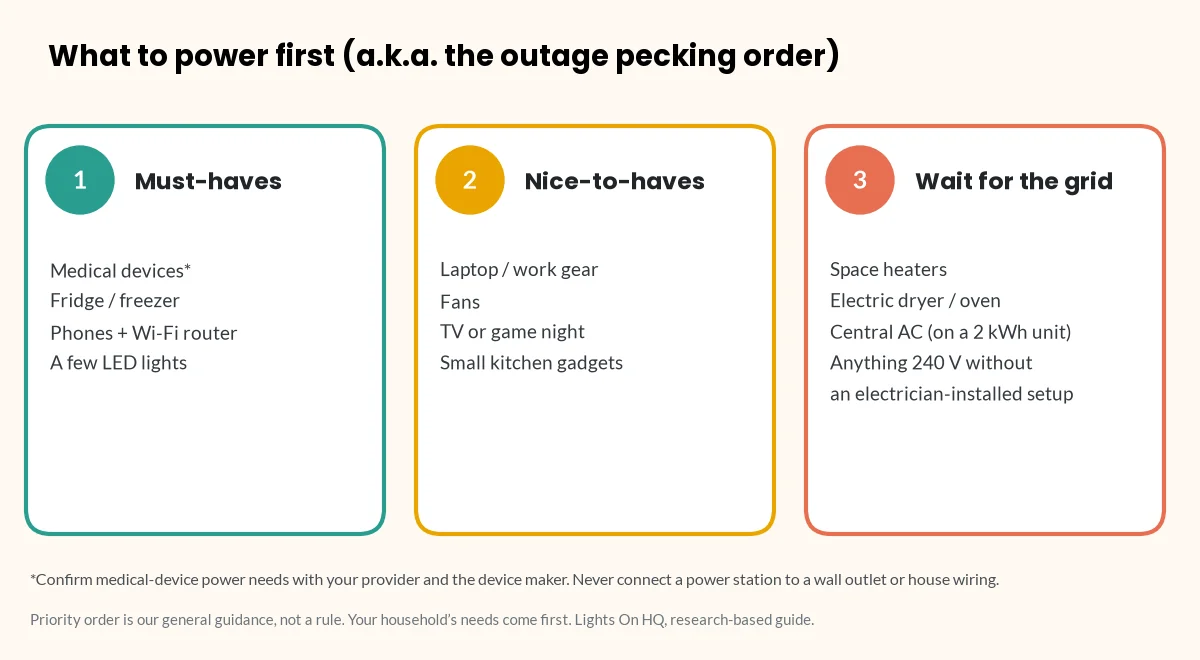
Power stations are batteries, not magic. Run the must-haves (medical devices, fridge, communication) first, the nice-to-haves (lights, laptop, fans) second, and save the “lol no” loads (space heaters, electric dryers, central AC on a 2 kWh unit) for when the grid comes back.
⚠️ Safety note: medical devices
*For CPAP and other medical devices, confirm power needs and compatibility with your provider and the device maker. Don’t rely on a power station as your only plan for life-sustaining equipment. BLUETTI’s AC200L manual, for example, excludes use with devices that require a high-performance UPS, including medical equipment, from its warranty coverage (manual PDF). CPAP sizing guide
What spec sheets can’t tell you
- Real usable capacity. Expect roughly 75–80% of rated Wh at the AC outlet. Our planning rule is rated Wh × 0.8 (a judgment call based on manufacturer runtime formulas).
- Fan noise, app quality, customer service and long-term reliability. These need hands-on use or lots of owner reports. We don’t have that data, and we won’t make it up.
- Prices. They move constantly. Every price here is a brand-store price checked Oct 16, 2026. Confirm before you buy.
Related
- What size power station do I need?
- EcoFlow vs Jackery vs Bluetti vs Anker SOLIX
- Power station vs gas generator
- Cost per watt-hour value table
- All use-case guides (hub)
Last checked: October 16, 2026. Found an error? Tell us and we’ll fix it and note the change.