Category: Use-Case Buying Guides

  • Best Power Station for CPAP: How Many Nights Will You Get?

    Best Power Station for CPAP: How Many Nights Will You Get?

    Disclosure: Lights On HQ is reader-supported. If you buy through links on this page we may earn a commission, at no extra cost to you. Full disclosure.

    Research-based, not hands-on tested. Specs come from manufacturer US product pages, checked October 16, 2026 (see our spec database). Runtimes are calculated estimates. See how we research.

    ⚡ Quick answer

    • A CPAP without the heated humidifier often draws somewhere around 30 to 60 W; with heat it can be 90 W or more. Check your machine’s power supply label or manual for real numbers.
    • At ~40 W for 8 hours, a ~1,000 Wh unit (EcoFlow DELTA 3, Jackery Explorer 1000 v2, BLUETTI AC180, Anker SOLIX C1000) works out to roughly 2.5 to 3 nights per charge.
    • The biggest runtime trick: turn off the heated humidifier (ask your doctor or equipment provider first) or use a DC power cord made for your machine.
    • Medical note: talk to your doctor or CPAP supplier before relying on battery power for therapy.
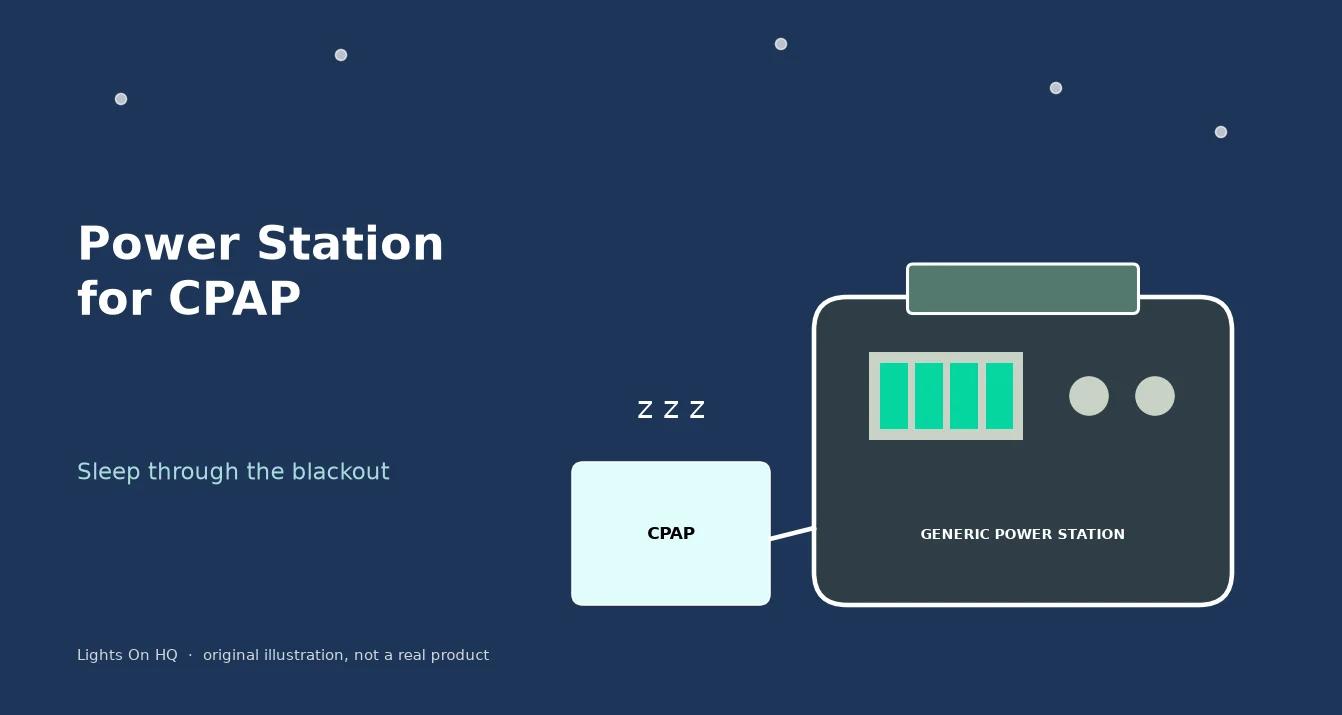
    Illustration of a CPAP machine plugged into a generic, unbranded power station at night with "z z z" above it.
    Sleep through the blackout. (Original illustration; generic unit, not a real product.)

    Power goes out. The fridge can wait a few hours. Your sleep can’t. If you use a CPAP, a blackout isn’t just a nuisance, it’s a rough night (or several). The good news: CPAPs are one of the easiest things to keep running on a portable power station.

    Step 1: Find your CPAP’s real wattage

    Flip over the power brick. You’ll see an output rating (volts × amps). That’s the maximum it can draw, not what it uses all night. Real use is usually lower, and the heated humidifier and heated tube are the big energy hogs.

    Your machine’s manual or manufacturer support page often lists typical power use with and without humidification. That’s the number you want.

    Step 2: Do the 10-second math

    Here’s the formula we use in our runtime calculator:

    Nights ≈ battery Wh × 0.85 ÷ (CPAP watts × hours of sleep)

    The 0.85 covers inverter losses (turning battery DC into wall-style AC). Example: a 1,024 Wh unit running a 40 W CPAP for 8 hours: 1,024 × 0.85 ÷ 320 ≈ 2.7 nights.
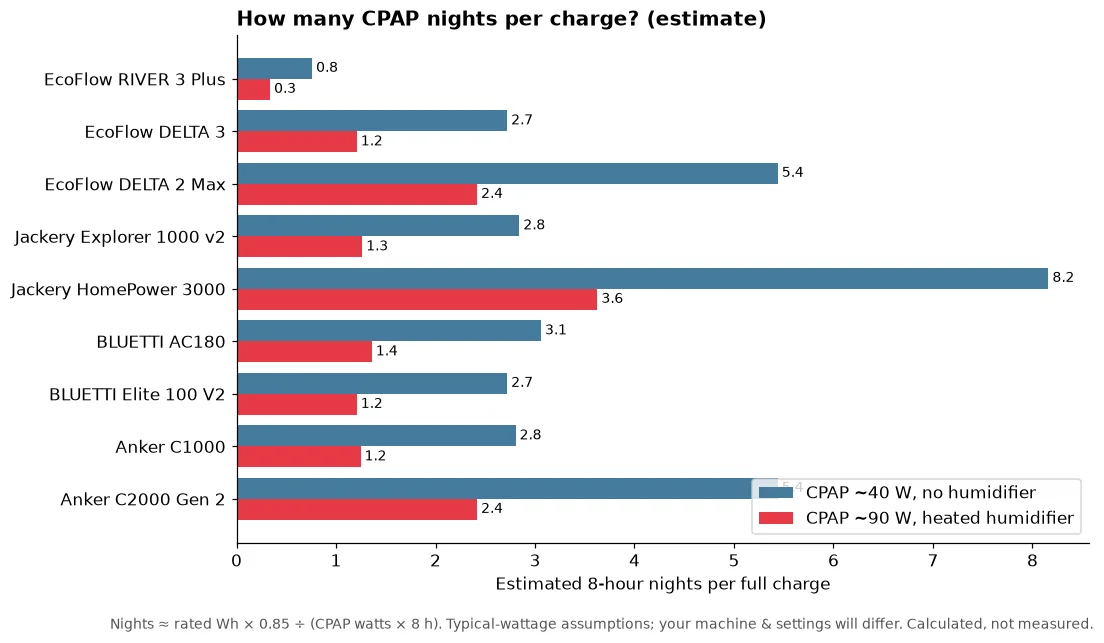
    Bar chart of estimated 8-hour CPAP nights per full charge for nine power stations at about 40 W (no humidifier) and 90 W (heated humidifier), from about 0.8 night on the 286 Wh RIVER 3 Plus to about 8.2 nights on the 3,072 Wh Jackery HomePower 3000.
    Estimated nights per charge. Calculated from rated capacity, not measured.

    Estimated CPAP nights per charge

    Model Capacity ~40 W (no humidifier) ~90 W (heated humidifier) Weight Store price (Oct 16)
    EcoFlow RIVER 3 Plus 286 Wh ~0.8 night ~0.3 night 10.4 lb $299
    EcoFlow DELTA 3 1,024 Wh ~2.7 ~1.2 27.6 lb $629
    BLUETTI Elite 100 V2 1,024 Wh ~2.7 ~1.2 25.3 lb $499
    Jackery Explorer 1000 v2 1,070 Wh ~2.8 ~1.3 23.8 lb $519
    Anker SOLIX C1000 1,056 Wh ~2.8 ~1.2 28.4 lb $599.99
    BLUETTI AC180 1,152 Wh ~3.1 ~1.4 35.3 lb $499
    EcoFlow DELTA 2 Max 2,048 Wh ~5.4 ~2.4 50 lb $1,049
    Anker SOLIX C2000 Gen 2 2,048 Wh ~5.4 ~2.4 41.7 lb $999.99
    Jackery HomePower 3000 3,072 Wh ~8.2 ~3.6 59.5 lb $1,349

    Calculated estimates with typical wattages, not measurements. Prices change often; click through for current pricing.

    Our picks by situation

    • “I just need one night, maybe two”: a ~1 kWh unit is the sweet spot. The Jackery Explorer 1000 v2 is the lightest here at 23.8 lb; the BLUETTI AC180 squeezes in a bit more capacity (1,152 Wh) at $499 on our check date.
    • “Outages here last days”: step up to ~2 kWh, like the Anker SOLIX C2000 Gen 2 or EcoFlow DELTA 2 Max. Add solar and you can top up during the day (see our solar pairing guide).
    • “Also want the fridge running”: a fridge changes everything. Read how long a power station runs a fridge first.

    Sneaky ways to stretch runtime

    1. Humidifier off (if your provider says that’s OK). It’s the biggest single saver.
    2. Go DC. Many CPAP makers sell a DC cord. Skipping the inverter avoids the conversion losses. Use only the cord your manufacturer approves.
    3. Keep the unit plugged in to the wall every night. Many units can pass power through, so you start every outage with a full battery. Some list a UPS-style switchover time (for example, EcoFlow lists <10 ms for the DELTA 3), but check whether your specific model and CPAP are a good match.
    4. Charge phones elsewhere if you’re tight on capacity.

    ⚠️ Safety stuff, short version

    • Ask your doctor or CPAP supplier before relying on battery power for therapy.
    • Keep the power station on a hard, dry surface with airflow, not under blankets.
    • Never plug a power station into a wall outlet to “power the house.” That’s backfeeding and it can kill utility workers. Whole-home setups need a transfer switch installed by a licensed electrician.

    Bottom line

    A CPAP is a featherweight load. A ~1 kWh LiFePO4 unit covers a couple of nights for most people, and a 2 kWh unit gives you breathing room (pun fully intended). Plug your real numbers into the runtime calculator, compare models in the spec database, or try our Blackout Survival Challenge to see how long you’d last.
  • Best Power Station for Camping and RV Trips (Without Breaking Your Back)

    Best Power Station for Camping and RV Trips (Without Breaking Your Back)

    Disclosure: Lights On HQ is reader-supported. If you buy through links on this page we may earn a commission, at no extra cost to you. Full disclosure.

    Research-based, not hands-on tested. Specs come from manufacturer US product pages, checked October 16, 2026 (see our spec database). Runtimes are calculated estimates. See how we research.

    ⚡ Quick answer

    • Weekend tent camping (phones, lights, fan, CPAP): a small or ~1 kWh unit. The EcoFlow RIVER 3 Plus (286 Wh, 10.4 lb) is the grab-and-go option; the Jackery Explorer 1000 v2 (1,070 Wh, 23.8 lb) is the do-it-all one.
    • Car camping with a 12 V fridge or coffee maker: go ~1 kWh with 1,800 W output, like the BLUETTI AC180 or EcoFlow DELTA 3.
    • RV / van life: ~2 kWh plus lots of solar. The BLUETTI Elite 200 V2 (2,073.6 Wh, 1,000 W solar) or Anker SOLIX C2000 Gen 2 (2,048 Wh, 41.7 lb).
    • Rule of thumb: above ~40 lb, it’s a two-person or wheels situation.
    Illustration of an orange tent under a sun next to a generic, unbranded power station.
    Cold drinks, charged phones, happy campers. (Original illustration; generic unit, not a real product.)

    Camping used to mean dead phones by day two and warm drinks by noon. Now? A battery the size of a cooler keeps the string lights glowing and the speaker playing. The trick is buying enough battery without buying something you’ll curse every time you lift it out of the trunk.

    The camping trade-off: capacity vs weight

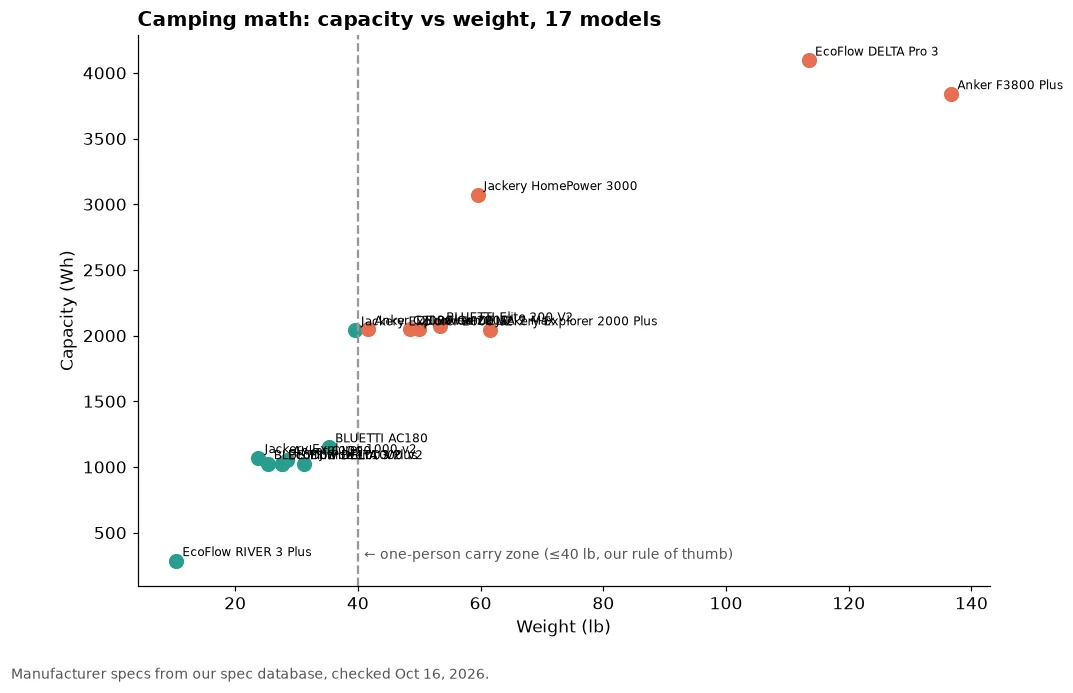
    More watt-hours means more weight. LiFePO4 batteries (which all 17 models in our database use) last for thousands of cycles, but they’re not light.

    Scatter plot of capacity in watt-hours versus weight in pounds for 17 power stations, with a dashed line at 40 lb marking a one-person carry zone.
    Bigger battery, heavier box. Manufacturer specs, checked Oct 16, 2026.
    Model Capacity Weight AC output Max solar Price (Oct 16)
    EcoFlow RIVER 3 Plus 286 Wh 10.4 lb 600 W 220 W $299
    Jackery Explorer 1000 v2 1,070 Wh 23.8 lb 1,500 W 400 W $519
    BLUETTI Elite 100 V2 1,024 Wh 25.3 lb 1,800 W 1,000 W $499
    EcoFlow DELTA 3 1,024 Wh 27.6 lb 1,800 W 500 W $629
    BLUETTI AC180 1,152 Wh 35.3 lb 1,800 W 500 W $499
    Anker SOLIX C2000 Gen 2 2,048 Wh 41.7 lb 2,400 W 800 W $999.99
    BLUETTI Elite 200 V2 2,073.6 Wh 53.4 lb 2,600 W 1,000 W $899

    What can you actually run at camp?

    Using typical wattages (always check your device labels) and our 0.85 efficiency rule:

    • Phone charge (~10 W for 3 h): trivial. Even the RIVER 3 Plus handles a whole group’s phones.
    • LED string lights (~10 W): all night on anything here.
    • Box fan (~60 W): about 4 hours on the RIVER 3 Plus, about 14 hours on a ~1 kWh unit.
    • CPAP (~40 W): see our CPAP guide for nights per charge.
    • Coffee maker (~900 W): needs a unit with more than 900 W output, so the 600 W RIVER 3 Plus is out. A ~1 kWh unit can brew a pot and barely notice.
    • Electric griddle or kettle: big resistive loads. Fine for short bursts on 1,800 W+ units; they eat battery fast.

    RV and van life: think “recharge,” not just “capacity”

    On the road, you’re recharging daily, so solar input matters as much as battery size. A unit that takes 1,000 W of solar (BLUETTI Elite 100 V2 and Elite 200 V2, EcoFlow DELTA 3 Plus, DELTA 2 Max) can refill much faster on a sunny day than one capped at 400 W. Our solar pairing guide explains how to match panels without tripping the input limits.

    Note: plugging into an RV’s power inlet is an RV-specific setup. Follow your RV and power station manuals, and get a qualified RV tech involved for anything beyond plugging in a cord.

    Campsite etiquette and safety

    • Batteries are silent, which your campground neighbors will love (way more than a generator; see power station vs gas generator).
    • Keep it shaded and dry. Heat and rain are no friends of electronics.
    • Strap it down in the car or RV so it doesn’t become a 40 lb projectile.

    Bottom line

    For most campers, a ~1 kWh LiFePO4 unit under 30 lb is the sweet spot. Go tiny for grab-and-go, go ~2 kWh plus solar for RVs. Plan your exact load in the runtime calculator and sort every model by weight in the spec database.

  • Best Portable Power Station for Home Backup (Research-Based Picks)

    Best Portable Power Station for Home Backup (Research-Based Picks)

    Disclosure: Lights On HQ is reader-supported. If you buy through links on this page we may earn a commission, at no extra cost to you. This doesn’t change which products we include or how we rank them. Read our full disclosure.

    Research-based, not hands-on tested. We haven’t tested these units ourselves. Specs and prices come from each manufacturer’s US product page or user manual, checked October 16, 2026, and linked below. See our methodology.

    📝 TL;DR

    • Just the essentials (Wi-Fi, phones, lights, a laptop): a ~1 kWh unit. Our spec pick: BLUETTI Elite 100 V2 ($499, ≤10 ms UPS, 1,000 W solar, 25.3 lb).
    • Fridge plus essentials: a ~2 kWh unit. Spec pick: BLUETTI Elite 200 V2 ($899, 2,073.6 Wh, ≤15 ms UPS, 6,000+ cycles to 80%). Want a published motor-surge figure? Look at the Anker SOLIX C2000 Gen 2 ($999.99, 4,000 W peak, 10 ms UPS).
    • Start small, grow later: BLUETTI AC200L (2,048 Wh, expandable to 8,192 Wh, $899) or EcoFlow DELTA 2 Max (expandable to 6,144 Wh, $1,049).
    • Big loads or 240 V (well pump, some central AC): EcoFlow DELTA Pro 3 or Anker SOLIX F3800 Plus, installed with a licensed electrician and a proper transfer switch or inlet.
    • Best value 3 kWh on our check date: Jackery HomePower 3000 ($1,349, about $0.44 per Wh).

    It’s 9:47 p.m. The wind has been showing off all evening, and then click: the house goes dark, the fridge goes quiet, and the router’s little lights fade like a sad birthday cake. Somebody yells “WHO TOUCHED THE BREAKER?” Nobody did. It’s the whole street.

    That’s the moment a home backup power station earns its keep. No fumes, no pull cord, no extension cord snaking out the window. Just plug in what matters and carry on.

    But “best” depends on what you need to keep running. So instead of one magic answer, here are research-based picks by tier, all from published specs.

    How we picked (no lab coats involved)

    We didn’t test these units by hand. We compared the spec sheets in our spec database on what matters most for home backup:

    1. Capacity (Wh): how long things run.
    2. Continuous and surge output (W): whether your fridge or pump will start at all.
    3. UPS switchover time: whether the router and PC ride through the outage without a reboot.
    4. Solar input: how fast you can refill during a multi-day outage.
    5. Expandability and 240 V: room to grow, and options for bigger home circuits.
    6. Price per Wh on our check date.

    Not sure how many watt-hours you need? Do the 10-minute sizing method first, or plug your list into the runtime calculator.

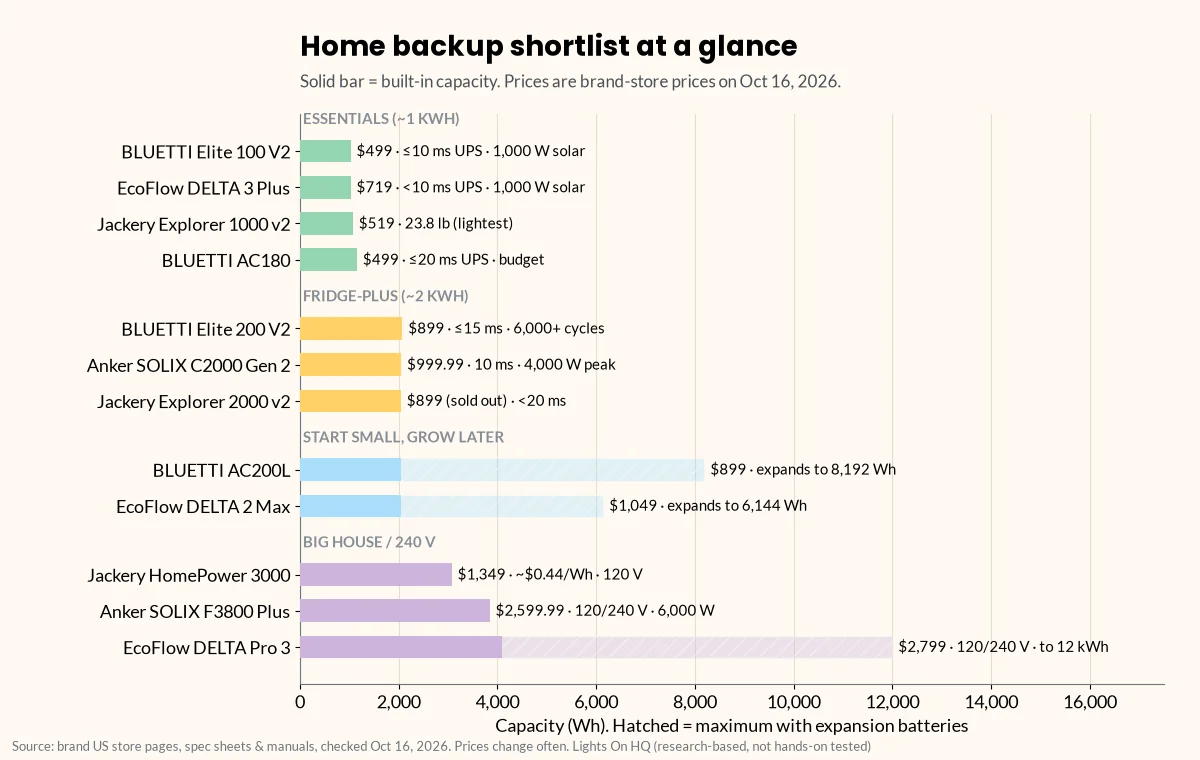
    Horizontal bar chart of the home backup shortlist grouped into four tiers: essentials around 1 kWh (BLUETTI Elite 100 V2, EcoFlow DELTA 3 Plus, Jackery Explorer 1000 v2, BLUETTI AC180), fridge-plus around 2 kWh (BLUETTI Elite 200 V2, Anker SOLIX C2000 Gen 2, Jackery Explorer 2000 v2), expandable (BLUETTI AC200L to 8,192 Wh, EcoFlow DELTA 2 Max to 6,144 Wh) and big house or 240 V (Jackery HomePower 3000, Anker SOLIX F3800 Plus, EcoFlow DELTA Pro 3 to 12 kWh), each labeled with price and key specs.
    The shortlist by tier. Solid bars are built-in capacity; hatched bars show the maximum with expansion batteries. Brand-store prices checked Oct 16, 2026.

    Tier 1: The essentials kit (~1 kWh)

    For: Wi-Fi, phones, LED lights, a laptop, maybe a CPAP*. Apartment dwellers, short outages, “I just need to work from home tomorrow.”

    Spec pick: BLUETTI Elite 100 V2

    • 1,024 Wh, 1,800 W AC output, ≤10 ms UPS, 1,000 W max solar, 25.3 lb, 4,000+ cycles to 80%.
    • $499 on BLUETTI’s US store on Oct 16, 2026 (BLUETTI).
    • Watch for: BLUETTI publishes no surge figure for it, so it’s best for electronics and lights, not motors.

    Also worth a look:

    • EcoFlow DELTA 3 Plus: 1,024 Wh, 1,800 W (3,600 W surge), <10 ms UPS, 1,000 W solar, 27.6 lb, $719. EcoFlow’s store said “ships mid-November” on our check date (EcoFlow). The DELTA 3 has the same capacity and output with 500 W solar for $629 (EcoFlow).
    • Jackery Explorer 1000 v2: the lightest 1 kWh-class unit in our database at about 23.8 lb (1,070 Wh, 1,500 W, 3,000 W surge, 400 W solar), $519. Jackery’s product page doesn’t list a UPS switchover time (Jackery).

    Check Elite 100 V2 price at BLUETTI

    ⚡ Quick take

    If you mostly care about keeping the internet and lights alive without a hiccup, a ~1 kWh unit with a ≤10 ms UPS is the sweet spot. It’s also small enough to live in a closet without becoming “that thing everyone trips over.”

    Tier 2: The fridge-plus kit (~2 kWh)

    For: a fridge plus the essentials for most of a day. The classic “save the groceries” setup. (Our worked example in the sizing guide uses about 2,320 Wh a day with a fridge, so a 2 kWh unit covers that list for roughly 17 hours.)

    Spec pick: BLUETTI Elite 200 V2

    • 2,073.6 Wh, 2,600 W, ≤15 ms UPS (per manual), 1,000 W solar, 6,000+ cycles to 80% (the longest rating we found), 53.4 lb, $899 (BLUETTI).
    • Watch for: its 3,900 W figure is “Power Lifting” for resistive loads only. BLUETTI’s manual says that mode isn’t for motor or compressor loads, and we didn’t find a separate motor-surge figure. If you’re starting a fridge or pump, check with BLUETTI.

    If a published surge figure matters to you (it should for motors):

    • Anker SOLIX C2000 Gen 2: 2,048 Wh, 2,400 W, 4,000 W peak, 10 ms UPS, 800 W solar, 41.7 lb, $999.99 (Anker).
    • Jackery Explorer 2000 v2: 2,042 Wh, 2,200 W, 4,400 W surge, <20 ms UPS, 39.5 lb, $899, but sold out on our check date (Jackery).

    Check Elite 200 V2 price at BLUETTI · Check C2000 Gen 2 price at Anker SOLIX

    More fridge detail: best power station to run a refrigerator.

    Tier 3: Start small, grow later (expandable 2 kWh)

    For: people who want a 2 kWh unit today and the option to bolt on more battery later.

    • BLUETTI AC200L: 2,048 Wh, 2,400 W, 7,200 W surge (BLUETTI’s product page), ≤20 ms UPS (user manual), 1,200 W solar, 62.4 lb, 3,000+ cycles to 80%. Expands with up to two B300 batteries to 8,192 Wh. Its outlets include a 120 V/30 A TT-30. $899 (compare-at $1,599) on Oct 16, 2026 (BLUETTI, manual PDF).
    • EcoFlow DELTA 2 Max: 2,048 Wh, 2,400 W (4,800 W surge), 1,000 W solar, 50 lb. Add up to two Smart Extra Batteries for 6,144 Wh. $1,049 (list $1,299). Its spec table doesn’t list a UPS switchover time (EcoFlow).

    Head to head: Bluetti AC200L vs EcoFlow DELTA 2 Max · expansion batteries explained

    Tier 4: The big-house kit (3–4 kWh, 240 V options)

    For: longer outages, more circuits, or 240 V appliances.

    • Jackery HomePower 3000 (best value on our check date): 3,072 Wh, 3,600 W (7,200 W surge), ~20 ms UPS, 1,000 W solar, 59.5 lb, $1,349, about $0.44 per Wh (Jackery). 120 V only.
    • EcoFlow DELTA Pro 3: 4,096 Wh, 4,000 W at 120/240 V, 8,000 W surge, 10 ms UPS, 2,600 W solar, 113.5 lb, expandable to 12 kWh as a single unit. $2,799 (EcoFlow).
    • Anker SOLIX F3800 Plus: 3,840 Wh, 6,000 W at 120/240 V, 3,200 W solar, 20 ms (grid to battery), 136.7 lb with wheels. $2,599.99 (Anker).

    ⚠️ Safety note: house circuits and 240 V

    Running a well pump or other hard-wired circuits means connecting to your home’s wiring. That job is for a licensed electrician with a proper transfer switch or power inlet. Never plug a power station (or any generator) into a wall outlet to “power the house.” That’s called backfeeding, and the CPSC warns it creates an electrocution risk for utility workers and neighbors (CPSC safety alert, PDF). Transfer switch explainer

    Budget tier: under $500-ish

    • BLUETTI AC180: 1,152 Wh, 1,800 W, about $0.43 per Wh at $499, ≤20 ms UPS per its manual. The manual says to turn off Grid Enhancement mode for UPS use (BLUETTI). Its 2,700 W figure is Power Lifting for resistive loads.
    • BLUETTI Elite 100 V2 and Jackery Explorer 1000 v2 (above) are $499 and $519.

    More: best budget power stations under $500

    The backup game plan (what to power first)

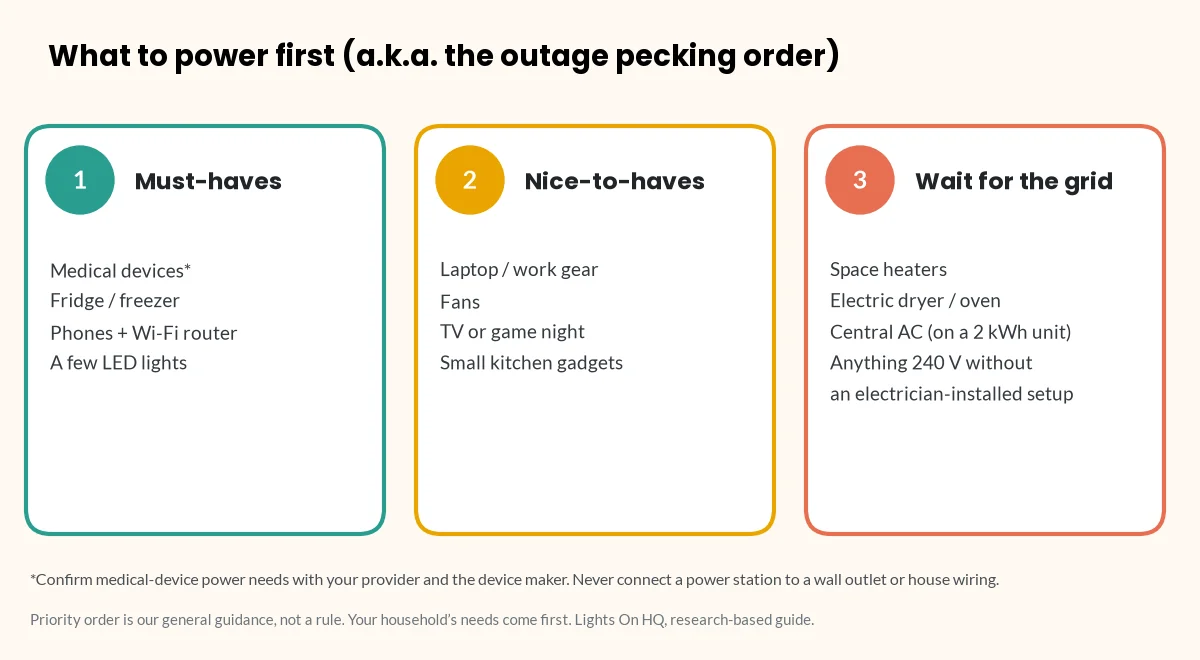
    Three-column diagram of outage priorities: 1, must-haves (medical devices, fridge or freezer, phones and Wi-Fi router, a few LED lights); 2, nice-to-haves (laptop, fans, TV, small kitchen gadgets); 3, wait for the grid (space heaters, electric dryer or oven, central AC on a 2 kWh unit, and anything 240 V without an electrician-installed setup).
    The outage pecking order: must-haves first, nice-to-haves second, big heat-makers when the grid comes back.

    ⚡ Quick take

    Power stations are batteries, not magic. Run the must-haves (medical devices, fridge, communication) first, the nice-to-haves (lights, laptop, fans) second, and save the “lol no” loads (space heaters, electric dryers, central AC on a 2 kWh unit) for when the grid comes back.

    ⚠️ Safety note: medical devices

    *For CPAP and other medical devices, confirm power needs and compatibility with your provider and the device maker. Don’t rely on a power station as your only plan for life-sustaining equipment. BLUETTI’s AC200L manual, for example, excludes use with devices that require a high-performance UPS, including medical equipment, from its warranty coverage (manual PDF). CPAP sizing guide

    What spec sheets can’t tell you

    • Real usable capacity. Expect roughly 75–80% of rated Wh at the AC outlet. Our planning rule is rated Wh × 0.8 (a judgment call based on manufacturer runtime formulas).
    • Fan noise, app quality, customer service and long-term reliability. These need hands-on use or lots of owner reports. We don’t have that data, and we won’t make it up.
    • Prices. They move constantly. Every price here is a brand-store price checked Oct 16, 2026. Confirm before you buy.

    Related

    Last checked: October 16, 2026. Found an error? Tell us and we’ll fix it and note the change.

  • Best Power Station to Run a Refrigerator During an Outage

    Best Power Station to Run a Refrigerator During an Outage

    Disclosure: Lights On HQ is reader-supported. If you buy through links on this page we may earn a commission, at no extra cost to you. Full disclosure.

    Research-based, not hands-on tested. We haven’t run these units on a fridge ourselves. Specs and prices come from manufacturer pages and manuals checked October 16, 2026; food-safety guidance is from FoodSafety.gov/USDA. See our methodology.

    📝 TL;DR

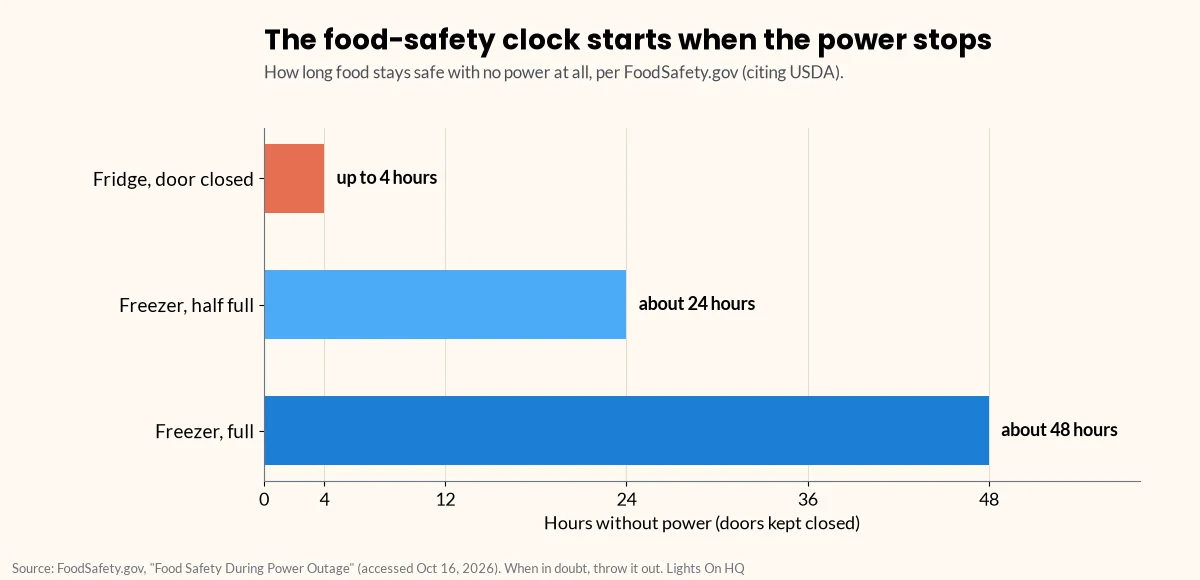
    • The clock is ticking: a closed fridge keeps food safe for up to 4 hours without power; a full freezer about 48 hours (24 if half full) (FoodSafety.gov).
    • Size by energy, not nameplate: use the kWh/year on the yellow EnergyGuide label. Example: 500 kWh/yr ≈ 1,370 Wh/day.
    • Check surge: fridge compressors need a startup spike. Pick a unit with a published surge rating, and ignore “boost” modes.
    • Our spec picks (~2 kWh): Anker SOLIX C2000 Gen 2 (4,000 W peak, 10 ms UPS), EcoFlow DELTA 2 Max (4,800 W surge, expandable), BLUETTI AC200L (7,200 W surge per BLUETTI, expandable to 8,192 Wh).
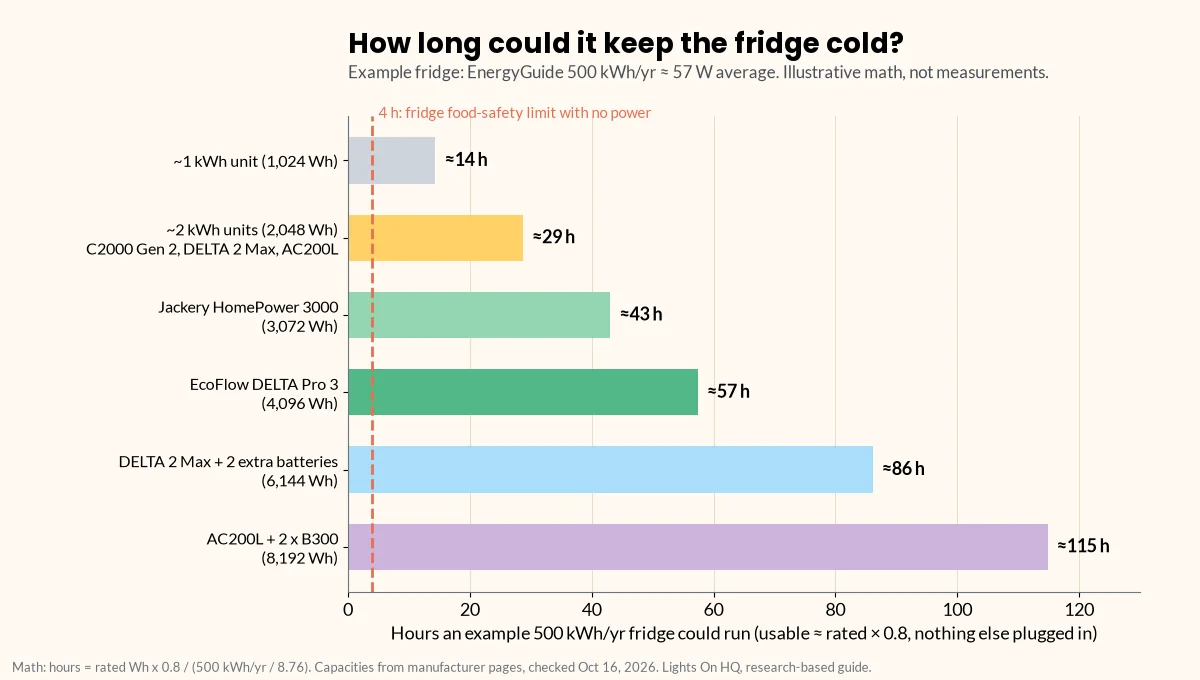
    • Example fridge (500 kWh/yr): about 29 hours on a ~2 kWh unit, 43 hours on 3 kWh (our 0.8 planning rule).

    Every outage has the same plot twist. First 10 minutes: “This is kind of cozy!” Hour two: someone opens the fridge “just to check,” and the whole family gasps like it’s a horror movie. Hour four: you’re Googling “is mayo still safe.”

    A power station that can keep your fridge humming turns that drama into a non-event. Here’s how to pick one that will actually start your fridge and keep it running long enough to matter.

    Step 1: Know your deadline

    According to FoodSafety.gov (citing USDA), your refrigerator keeps food safe for up to 4 hours during an outage if you keep the door closed. Perishables like meat, poultry, fish, eggs and leftovers should be thrown out after 4 hours without power. A full freezer holds a safe temperature for about 48 hours, or 24 hours if half full and the door stays shut (FoodSafety.gov).

    Bar chart of food-safety time limits with no power, per FoodSafety.gov citing USDA: a closed refrigerator keeps food safe for up to 4 hours, a half-full freezer about 24 hours, and a full freezer about 48 hours.
    No power at all? The clock: fridge up to 4 hours, freezer about 24 hours half full or 48 hours full (FoodSafety.gov).

    ⚡ Quick take

    Even a modest power station buys you time past that 4-hour line. The freezer is the patient one; the fridge is the drama queen. Keep both doors closed and let the battery do its thing.

    Step 2: Figure out how much energy your fridge uses

    Skip the nameplate watts. The compressor cycles on and off, so nameplate watts overstate daily use. Instead:

    • Find the yellow EnergyGuide label (or your model’s spec sheet) and read the kWh per year.
    • Daily Wh = (kWh per year ÷ 365) × 1,000. Example: 500 kWh/yr ÷ 365 × 1,000 ≈ 1,370 Wh/day, or about 57 W on average.
    • Most accurate: a plug-in watt meter for 24 hours.

    Then add a margin for losses. Our planning rule is usable Wh ≈ rated Wh × 0.8 (a judgment call based on manufacturer runtime formulas such as BLUETTI’s). Full math: how long will a 2,000 Wh power station run a fridge?

    Horizontal bar chart of how long an example refrigerator rated 500 kWh per year could run: about 14 hours on a 1,024 Wh unit, 29 hours on 2,048 Wh units, 43 hours on the 3,072 Wh Jackery HomePower 3000, 57 hours on the 4,096 Wh EcoFlow DELTA Pro 3, 86 hours on an expanded DELTA 2 Max (6,144 Wh) and 115 hours on an expanded BLUETTI AC200L (8,192 Wh), with a dashed line at the 4-hour food-safety limit.
    Illustrative math for a 500 kWh/yr fridge with nothing else plugged in: hours ≈ rated Wh × 0.8 ÷ 57 W.

    Step 3: Make sure it can start the compressor

    Fridges and freezers pull a short startup spike when the compressor kicks on, and that spike can be several times the running draw. Check your fridge’s manual or ask the manufacturer. Then:

    • The station’s continuous AC output must exceed everything running at once.
    • The station’s surge rating must cover the startup spike.
    • Ignore “boost” figures. EcoFlow’s “X-Boost” and BLUETTI’s “Power Lifting” are for heating appliances. BLUETTI’s manuals say Power Lifting isn’t for motor or compressor loads. More: surge vs running watts.

    The picks (by published specs)

    All prices are brand-store prices on Oct 16, 2026. “Example fridge hours” uses a 500 kWh/yr fridge and our 0.8 rule. It’s illustrative, not a measurement.

    Model Capacity AC out / surge UPS Solar in Weight Price Example fridge hours
    Anker SOLIX C2000 Gen 2 2,048 Wh 2,400 W / 4,000 W peak 10 ms 800 W 41.7 lb $999.99 ~29 h
    EcoFlow DELTA 2 Max 2,048 Wh (to 6,144) 2,400 W / 4,800 W not listed 1,000 W 50 lb $1,049 ~29 h (~86 h max expanded)
    BLUETTI AC200L 2,048 Wh (to 8,192) 2,400 W / 7,200 W† ≤20 ms 1,200 W 62.4 lb $899 ~29 h (~115 h max expanded)
    Jackery Explorer 2000 v2 2,042 Wh 2,200 W / 4,400 W <20 ms 400 W 39.5 lb $899 (sold out) ~29 h
    BLUETTI Elite 200 V2 2,073.6 Wh 2,600 W / not published for motors‡ ≤15 ms 1,000 W 53.4 lb $899 ~29 h
    Jackery HomePower 3000 3,072 Wh 3,600 W / 7,200 W ~20 ms 1,000 W 59.5 lb $1,349 ~43 h

    † BLUETTI’s AC200L product page lists 7,200 W surge; its user manual lists overload of 3,000–3,600 W for 5 seconds and over 3,600 W for 0.5 s. The two don’t match. Until BLUETTI clarifies, treat 7,200 W as the brand’s headline figure, not a guaranteed compressor-start rating. ‡ BLUETTI’s 3,900 W figure for the Elite 200 V2 is Power Lifting for resistive loads only. We didn’t find a separate motor-surge rating. Ask BLUETTI before relying on it for a fridge.

    Sources: Anker C2000 Gen 2, EcoFlow DELTA 2 Max, BLUETTI AC200L and manual, Jackery Explorer 2000 v2, BLUETTI Elite 200 V2, Jackery HomePower 3000.

    Best all-rounder for a fridge: Anker SOLIX C2000 Gen 2

    A published 4,000 W peak figure, a 10 ms UPS (so the fridge just keeps going when the grid drops) and a manageable 41.7 lb. Its 800 W solar input is mid-pack. Check C2000 Gen 2 price at Anker SOLIX

    Best for long outages with solar: EcoFlow DELTA 2 Max or BLUETTI AC200L

    Both start at 2,048 Wh and expand: the DELTA 2 Max to 6,144 Wh, the AC200L to 8,192 Wh. The AC200L takes 1,200 W of solar; the DELTA 2 Max takes 1,000 W. Downsides: the AC200L is the heaviest here at 62.4 lb, and EcoFlow doesn’t list a UPS switchover time for the DELTA 2 Max. Check DELTA 2 Max price at EcoFlow · Check AC200L price at BLUETTI

    Best value for a fridge and more: Jackery HomePower 3000

    About $0.44 per Wh on our check date, with 3,072 Wh and a 7,200 W surge rating. It’s 120 V only and 59.5 lb. Check HomePower 3000 price at Jackery

    ⚡ Quick take

    For a fridge, surge rating + UPS matter as much as capacity. A unit that can’t start the compressor is just a very expensive doorstop.

    Fridge outage tips that don’t need a battery

    • Keep the doors closed. That’s the single biggest thing FoodSafety.gov recommends.
    • When in doubt, throw it out, and never taste food to check if it’s safe (FoodSafety.gov).
    • Plug the fridge straight into the power station with the fridge’s own cord (or a properly rated cord). Don’t connect the station to a wall outlet or your home wiring.

    ⚠️ Safety notes

    • No backfeeding. Never plug a power station into a wall outlet to feed your house circuits; the CPSC warns this endangers utility workers and neighbors (CPSC, PDF). For hard-wired circuits, hire a licensed electrician to install a transfer switch or inlet. Transfer switch explainer
    • Food safety beats battery math. If the fridge was above 40°F for more than 2 hours, follow FoodSafety.gov’s chart, whatever the battery says.

    Related

    Last checked: October 16, 2026. Found an error? Tell us.