Disclosure: Lights On HQ is reader-supported. If you buy through links on this page we may earn a commission, at no extra cost to you. Full disclosure.
Research-based, not hands-on tested. Specs come from manufacturer US product pages, checked October 16, 2026 (see our spec database). Runtimes are calculated estimates. See how we research.
⚡ Quick answer
- A CPAP without the heated humidifier often draws somewhere around 30 to 60 W; with heat it can be 90 W or more. Check your machine’s power supply label or manual for real numbers.
- At ~40 W for 8 hours, a ~1,000 Wh unit (EcoFlow DELTA 3, Jackery Explorer 1000 v2, BLUETTI AC180, Anker SOLIX C1000) works out to roughly 2.5 to 3 nights per charge.
- The biggest runtime trick: turn off the heated humidifier (ask your doctor or equipment provider first) or use a DC power cord made for your machine.
- Medical note: talk to your doctor or CPAP supplier before relying on battery power for therapy.
Power goes out. The fridge can wait a few hours. Your sleep can’t. If you use a CPAP, a blackout isn’t just a nuisance, it’s a rough night (or several). The good news: CPAPs are one of the easiest things to keep running on a portable power station.
Step 1: Find your CPAP’s real wattage
Flip over the power brick. You’ll see an output rating (volts × amps). That’s the maximum it can draw, not what it uses all night. Real use is usually lower, and the heated humidifier and heated tube are the big energy hogs.
Your machine’s manual or manufacturer support page often lists typical power use with and without humidification. That’s the number you want.
Step 2: Do the 10-second math
Here’s the formula we use in our runtime calculator:
Nights ≈ battery Wh × 0.85 ÷ (CPAP watts × hours of sleep)
The 0.85 covers inverter losses (turning battery DC into wall-style AC). Example: a 1,024 Wh unit running a 40 W CPAP for 8 hours: 1,024 × 0.85 ÷ 320 ≈ 2.7 nights.
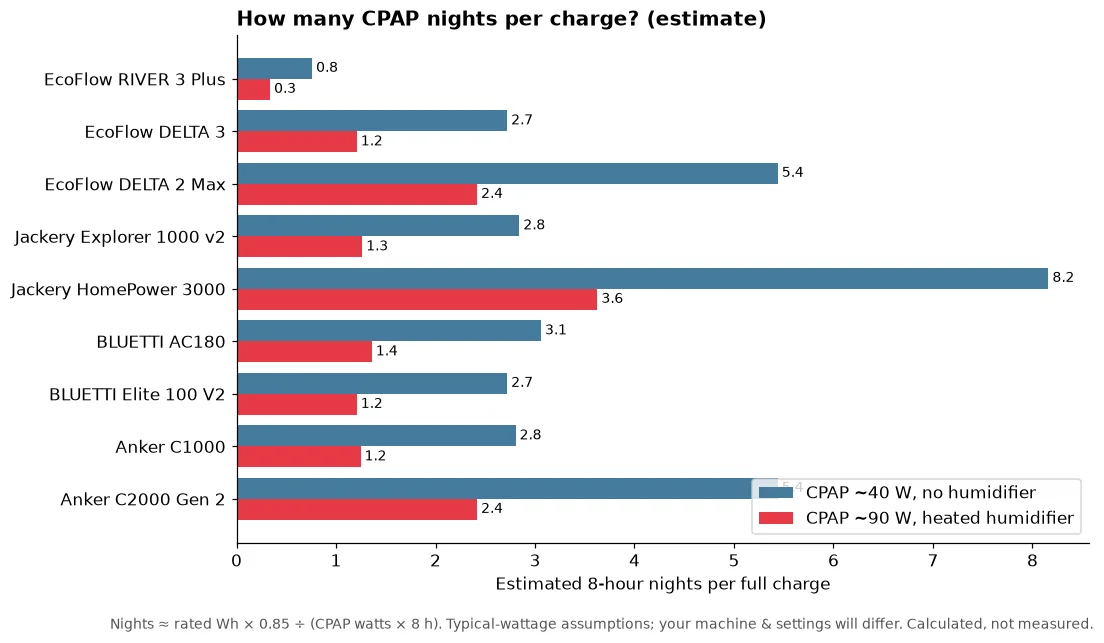
Estimated CPAP nights per charge
| Model | Capacity | ~40 W (no humidifier) | ~90 W (heated humidifier) | Weight | Store price (Oct 16) |
|---|---|---|---|---|---|
| EcoFlow RIVER 3 Plus | 286 Wh | ~0.8 night | ~0.3 night | 10.4 lb | $299 |
| EcoFlow DELTA 3 | 1,024 Wh | ~2.7 | ~1.2 | 27.6 lb | $629 |
| BLUETTI Elite 100 V2 | 1,024 Wh | ~2.7 | ~1.2 | 25.3 lb | $499 |
| Jackery Explorer 1000 v2 | 1,070 Wh | ~2.8 | ~1.3 | 23.8 lb | $519 |
| Anker SOLIX C1000 | 1,056 Wh | ~2.8 | ~1.2 | 28.4 lb | $599.99 |
| BLUETTI AC180 | 1,152 Wh | ~3.1 | ~1.4 | 35.3 lb | $499 |
| EcoFlow DELTA 2 Max | 2,048 Wh | ~5.4 | ~2.4 | 50 lb | $1,049 |
| Anker SOLIX C2000 Gen 2 | 2,048 Wh | ~5.4 | ~2.4 | 41.7 lb | $999.99 |
| Jackery HomePower 3000 | 3,072 Wh | ~8.2 | ~3.6 | 59.5 lb | $1,349 |
Calculated estimates with typical wattages, not measurements. Prices change often; click through for current pricing.
Our picks by situation
- “I just need one night, maybe two”: a ~1 kWh unit is the sweet spot. The Jackery Explorer 1000 v2 is the lightest here at 23.8 lb; the BLUETTI AC180 squeezes in a bit more capacity (1,152 Wh) at $499 on our check date.
- “Outages here last days”: step up to ~2 kWh, like the Anker SOLIX C2000 Gen 2 or EcoFlow DELTA 2 Max. Add solar and you can top up during the day (see our solar pairing guide).
- “Also want the fridge running”: a fridge changes everything. Read how long a power station runs a fridge first.
Sneaky ways to stretch runtime
- Humidifier off (if your provider says that’s OK). It’s the biggest single saver.
- Go DC. Many CPAP makers sell a DC cord. Skipping the inverter avoids the conversion losses. Use only the cord your manufacturer approves.
- Keep the unit plugged in to the wall every night. Many units can pass power through, so you start every outage with a full battery. Some list a UPS-style switchover time (for example, EcoFlow lists <10 ms for the DELTA 3), but check whether your specific model and CPAP are a good match.
- Charge phones elsewhere if you’re tight on capacity.
⚠️ Safety stuff, short version
- Ask your doctor or CPAP supplier before relying on battery power for therapy.
- Keep the power station on a hard, dry surface with airflow, not under blankets.
- Never plug a power station into a wall outlet to “power the house.” That’s backfeeding and it can kill utility workers. Whole-home setups need a transfer switch installed by a licensed electrician.
Bottom line
A CPAP is a featherweight load. A ~1 kWh LiFePO4 unit covers a couple of nights for most people, and a 2 kWh unit gives you breathing room (pun fully intended). Plug your real numbers into the runtime calculator, compare models in the spec database, or try our Blackout Survival Challenge to see how long you’d last.