Disclosure: Lights On HQ is reader-supported. If you buy through links on this page we may earn a commission, at no extra cost to you. Full disclosure.
Research-based, not hands-on tested. Specs come from manufacturer US product pages, checked October 16, 2026 (see our spec database). Runtimes are calculated estimates. See how we research.
⚡ Quick answer
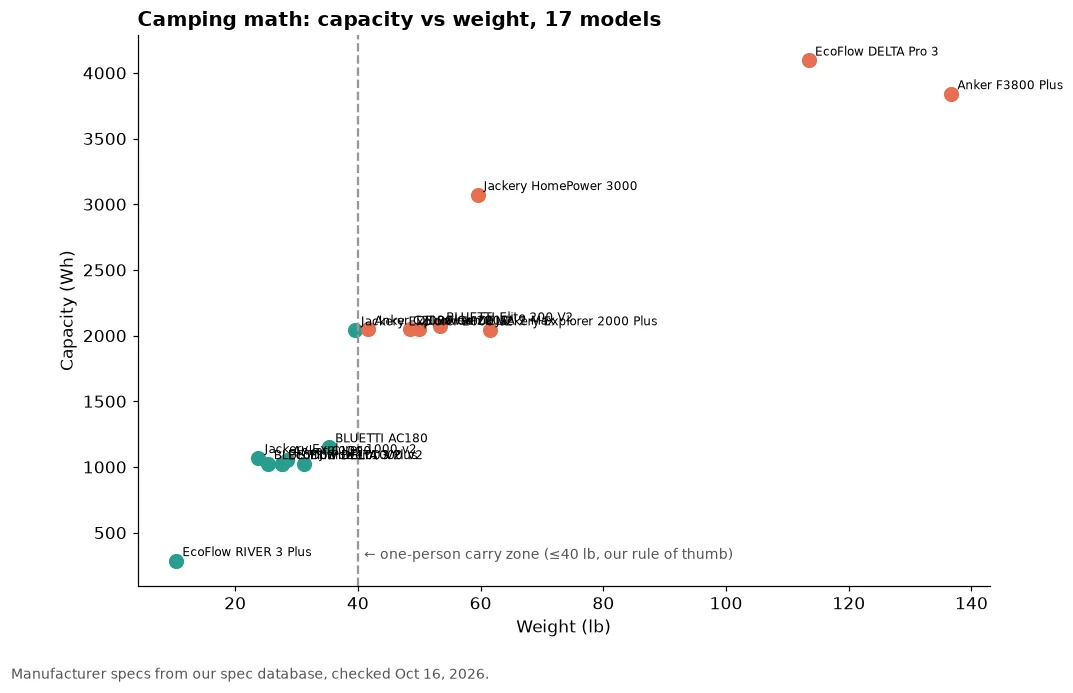
- Weekend tent camping (phones, lights, fan, CPAP): a small or ~1 kWh unit. The EcoFlow RIVER 3 Plus (286 Wh, 10.4 lb) is the grab-and-go option; the Jackery Explorer 1000 v2 (1,070 Wh, 23.8 lb) is the do-it-all one.
- Car camping with a 12 V fridge or coffee maker: go ~1 kWh with 1,800 W output, like the BLUETTI AC180 or EcoFlow DELTA 3.
- RV / van life: ~2 kWh plus lots of solar. The BLUETTI Elite 200 V2 (2,073.6 Wh, 1,000 W solar) or Anker SOLIX C2000 Gen 2 (2,048 Wh, 41.7 lb).
- Rule of thumb: above ~40 lb, it’s a two-person or wheels situation.
Camping used to mean dead phones by day two and warm drinks by noon. Now? A battery the size of a cooler keeps the string lights glowing and the speaker playing. The trick is buying enough battery without buying something you’ll curse every time you lift it out of the trunk.
The camping trade-off: capacity vs weight
More watt-hours means more weight. LiFePO4 batteries (which all 17 models in our database use) last for thousands of cycles, but they’re not light.
| Model | Capacity | Weight | AC output | Max solar | Price (Oct 16) |
|---|---|---|---|---|---|
| EcoFlow RIVER 3 Plus | 286 Wh | 10.4 lb | 600 W | 220 W | $299 |
| Jackery Explorer 1000 v2 | 1,070 Wh | 23.8 lb | 1,500 W | 400 W | $519 |
| BLUETTI Elite 100 V2 | 1,024 Wh | 25.3 lb | 1,800 W | 1,000 W | $499 |
| EcoFlow DELTA 3 | 1,024 Wh | 27.6 lb | 1,800 W | 500 W | $629 |
| BLUETTI AC180 | 1,152 Wh | 35.3 lb | 1,800 W | 500 W | $499 |
| Anker SOLIX C2000 Gen 2 | 2,048 Wh | 41.7 lb | 2,400 W | 800 W | $999.99 |
| BLUETTI Elite 200 V2 | 2,073.6 Wh | 53.4 lb | 2,600 W | 1,000 W | $899 |
What can you actually run at camp?
Using typical wattages (always check your device labels) and our 0.85 efficiency rule:
- Phone charge (~10 W for 3 h): trivial. Even the RIVER 3 Plus handles a whole group’s phones.
- LED string lights (~10 W): all night on anything here.
- Box fan (~60 W): about 4 hours on the RIVER 3 Plus, about 14 hours on a ~1 kWh unit.
- CPAP (~40 W): see our CPAP guide for nights per charge.
- Coffee maker (~900 W): needs a unit with more than 900 W output, so the 600 W RIVER 3 Plus is out. A ~1 kWh unit can brew a pot and barely notice.
- Electric griddle or kettle: big resistive loads. Fine for short bursts on 1,800 W+ units; they eat battery fast.
RV and van life: think “recharge,” not just “capacity”
On the road, you’re recharging daily, so solar input matters as much as battery size. A unit that takes 1,000 W of solar (BLUETTI Elite 100 V2 and Elite 200 V2, EcoFlow DELTA 3 Plus, DELTA 2 Max) can refill much faster on a sunny day than one capped at 400 W. Our solar pairing guide explains how to match panels without tripping the input limits.
Note: plugging into an RV’s power inlet is an RV-specific setup. Follow your RV and power station manuals, and get a qualified RV tech involved for anything beyond plugging in a cord.
Campsite etiquette and safety
- Batteries are silent, which your campground neighbors will love (way more than a generator; see power station vs gas generator).
- Keep it shaded and dry. Heat and rain are no friends of electronics.
- Strap it down in the car or RV so it doesn’t become a 40 lb projectile.
Bottom line
For most campers, a ~1 kWh LiFePO4 unit under 30 lb is the sweet spot. Go tiny for grab-and-go, go ~2 kWh plus solar for RVs. Plan your exact load in the runtime calculator and sort every model by weight in the spec database.