
Disclosure: Lights On HQ is reader-supported. If you buy through links on this page we may earn a commission, at no extra cost to you. Full disclosure.
Research-based data page. We haven’t tested these units. Prices are each brand’s own US store price, checked October 16, 2026; capacities and cycle ratings are from manufacturer pages and manuals. We plan to refresh this table monthly. See our methodology.
📝 TL;DR
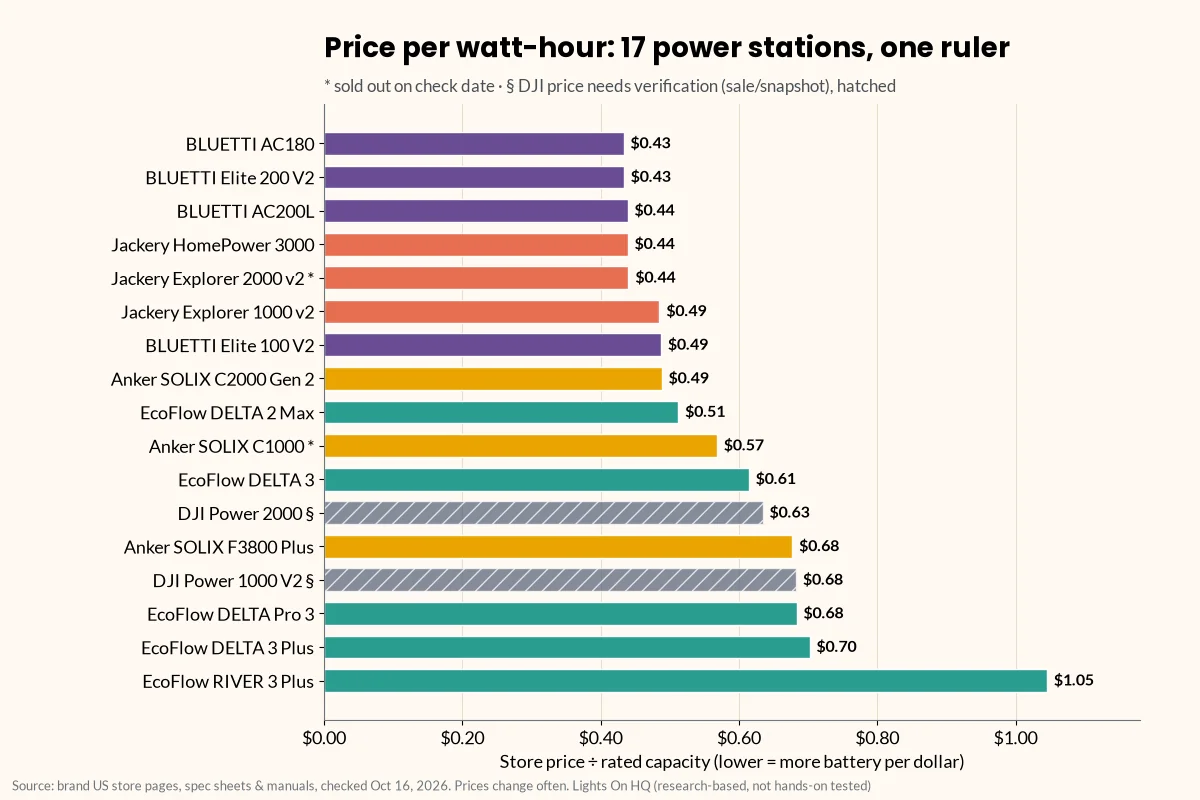
- Cheapest per Wh on Oct 16, 2026: BLUETTI AC180 and Elite 200 V2 (about $0.43/Wh), then BLUETTI AC200L, Jackery HomePower 3000 and Explorer 2000 v2 (about $0.44/Wh; the Explorer 2000 v2 was sold out).
- Small units always look pricey per Wh. The 286 Wh EcoFlow RIVER 3 Plus is $1.05/Wh. That’s normal.
- Best rough “lifetime” value: the Elite 200 V2 at about $0.07 per rated kWh over its rated cycles, thanks to its 6,000+ cycle rating.
- $/Wh isn’t the whole story. Surge, UPS speed, solar input and weight can be worth paying for.
Shopping for a power station is a bit like shopping for cereal. The big box looks like a deal, the tiny box costs a fortune per flake, and the “SALE!” sticker might be the regular price wearing a fake mustache.
Price per watt-hour cuts through that. It’s simple: store price ÷ rated capacity. Lower means more battery per dollar. This page lists it for every model in our spec database, plus a rough cost per lifetime kWh for the cycle-rating nerds (hi, welcome).
The value table
Prices are brand-store prices on Oct 16, 2026. They aren’t live and change often. Confirm before you buy. Sorted by $/Wh, cheapest first.
| Brand | Model | Capacity (Wh) | Store price | $/Wh | Rated cycles | ~$ per lifetime kWh‡ |
|---|---|---|---|---|---|---|
| BLUETTI | AC180 | 1,152 | $499 | $0.43 | 3,500+ | $0.12 |
| BLUETTI | Elite 200 V2 | 2,073.6 | $899 | $0.43 | 6,000+ to 80% | $0.07 |
| BLUETTI | AC200L | 2,048 | $899 | $0.44 | 3,000+ to 80% | $0.15 |
| Jackery | HomePower 3000 | 3,072 | $1,349 | $0.44 | 4,000 to 70% | $0.11 |
| Jackery | Explorer 2000 v2 | 2,042 | $899 (sold out) | $0.44 | 4,000 to 70% | $0.11 |
| Jackery | Explorer 1000 v2 | 1,070 | $519 | $0.49 | 4,000 to 70% | $0.12 |
| BLUETTI | Elite 100 V2 | 1,024 | $499 | $0.49 | 4,000+ to 80% | $0.12 |
| Anker SOLIX | C2000 Gen 2 | 2,048 | $999.99 | $0.49 | 4,000 | $0.12 |
| EcoFlow | DELTA 2 Max | 2,048 | $1,049 | $0.51 | 3,000 to 80% | $0.17 |
| Anker SOLIX | C1000 | 1,056 | $599.99 (sold out) | $0.57 | 3,000 to 80% | $0.19 |
| EcoFlow | DELTA 3 | 1,024 | $629 | $0.61 | 4,000 to 80% | $0.15 |
| DJI | Power 2000 | 2,048 | $1,299§ | $0.63 | 4,000 to 80% | $0.16 |
| Anker SOLIX | F3800 Plus | 3,840 | $2,599.99 | $0.68 | 3,000+ | $0.23 |
| DJI | Power 1000 V2 | 1,024 | $699§ | $0.68 | 4,000 to 80% | $0.17 |
| EcoFlow | DELTA Pro 3 | 4,096 | $2,799 | $0.68 | 4,000 to 80% | $0.17 |
| EcoFlow | DELTA 3 Plus | 1,024 | $719 | $0.70 | 4,000 to 80% | $0.18 |
| EcoFlow | RIVER 3 Plus | 286 | $299 | $1.05 | 3,000 to 80% | $0.35 |
‡ Rough cost per lifetime kWh = price ÷ (rated kWh × rated cycles). It’s a back-of-napkin battery-wear figure. It ignores usable-capacity losses, capacity fade, charging electricity and the different end points (70% vs 80%), so treat it as a ranking hint, not a promise. § DJI prices need a second look. djiusa.com showed the Power 1000 V2 on sale at $399.98 vs a regular $699 (about $0.39/Wh at the sale price). The Power 2000 price came from a search snapshot, not a live page, because DJI’s store renders prices in JavaScript. Some DJI specs in our database are from third-party listings.
Not ranked: Jackery’s Explorer 2000 Plus page showed $2,499 against a $5,799 “compare at,” which looks like a bundle or default variant rather than the base unit. We’ll add it once we can confirm the base price.
Sources for every row are in the spec database. Examples: BLUETTI Elite 200 V2, BLUETTI AC200L, Jackery HomePower 3000, Anker SOLIX C2000 Gen 2, EcoFlow DELTA 2 Max, DJI Power 2000.
Check Elite 200 V2 price at BLUETTI · Check HomePower 3000 price at Jackery
Why small units cost more per Wh
Every power station has fixed costs regardless of battery size: the inverter, the case, the screen, the outlets, the charger. On a small unit those costs are spread over fewer watt-hours. So a 286 Wh unit at $1.05/Wh isn’t a rip-off; it’s just the snack-size bag.
⚡ Quick take
Compare $/Wh within the same size class. A 1 kWh unit at $0.49 and a 2 kWh unit at $0.44 are both good deals for their size.
The “lifetime” angle: cost per rated kWh
$/Wh tells you what you pay today. Cost per lifetime kWh hints at what you pay per unit of battery wear over the rated cycle life.
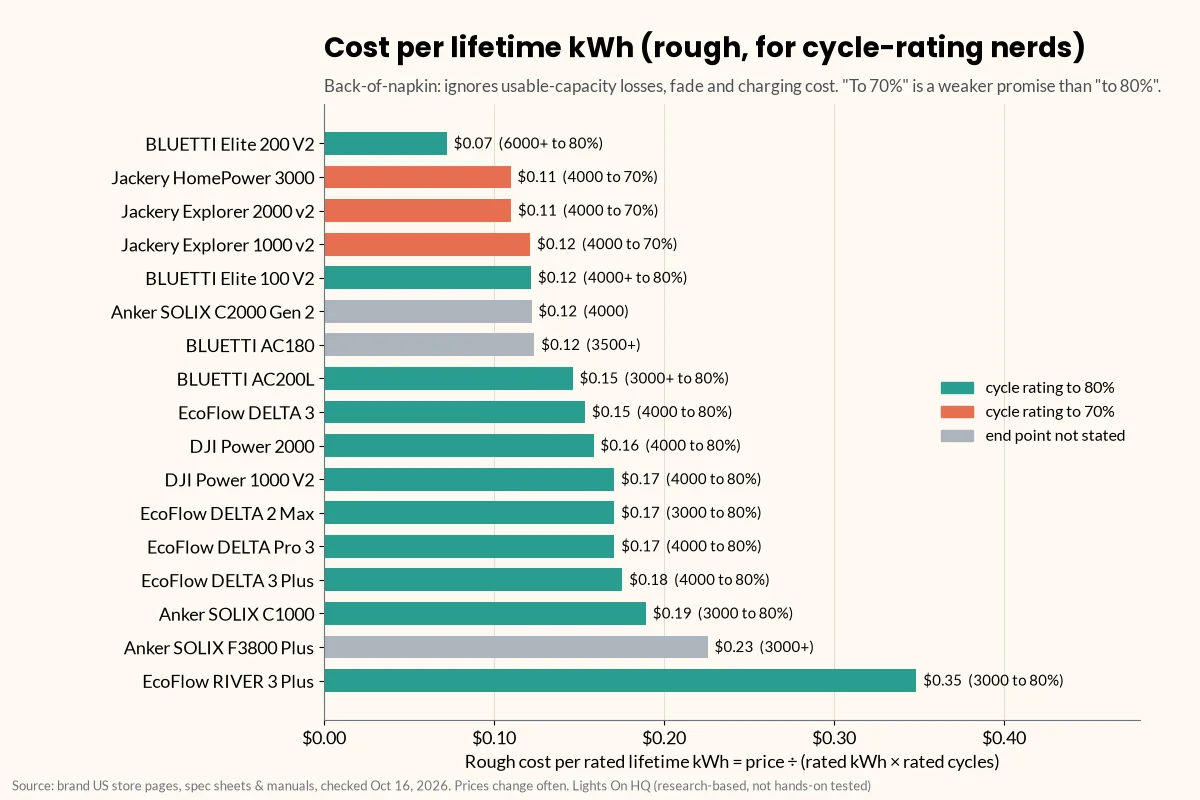
The standout is the BLUETTI Elite 200 V2: a low $/Wh and a 6,000+ cycle rating (to 80%) gives it about $0.07 per rated kWh. Jackery’s units also look good here, but remember their cycle ratings are to 70% capacity, a weaker promise than “to 80%.” More on that in our four-brand comparison.
For a backup unit used a few dozen times a year, you’ll likely never hit the rated cycles anyway. So for most home-backup buyers, today’s $/Wh matters more than lifetime math.
When paying more per Wh is worth it
Cheapest per Wh isn’t automatically best. Things worth paying for, depending on your needs:
- Fast UPS switchover (10 ms or less) for routers, PCs and NAS boxes.
- A published surge rating if you’ll start a fridge, freezer or pump. Boost modes like X-Boost and Power Lifting are for heating loads, not motors.
- More solar input for multi-day outages.
- 240 V output (EcoFlow DELTA Pro 3, Anker SOLIX F3800 Plus) for well pumps or some central AC, installed by a licensed electrician with a transfer switch or inlet.
- Lower weight if you’ll carry it around.
- Expandability, so you can add capacity instead of buying a second unit. Expansion batteries explained
⚠️ Safety note
A great price per Wh doesn’t change the safety rules. Never connect a power station to a wall outlet or home wiring (“backfeeding”); the CPSC warns it endangers utility workers and neighbors (CPSC, PDF). For CPAP or other medical devices, confirm with your provider and the device maker.
How we keep this table honest
- Brand-store prices only, each stamped with the date we checked. We don’t show Amazon prices in this table.
- Monthly refresh. Prices and stock change constantly; sales are frequent.
- Flags, not guesses. If a price looks like a bundle, came from a snapshot or a sale, we say so.
Related
- Full spec database
- Best portable power station for home backup
- Best budget power stations under $500
- Runtime calculator
- Sizing & runtime guides (hub)
Prices last checked: October 16, 2026. Found an error? Tell us.