Disclosure: Lights On HQ is reader-supported. If you buy through links on this page we may earn a commission, at no extra cost to you. Full disclosure.
Research-based, not hands-on tested. We haven’t run these units on a fridge ourselves. Specs and prices come from manufacturer pages and manuals checked October 16, 2026; food-safety guidance is from FoodSafety.gov/USDA. See our methodology.
📝 TL;DR
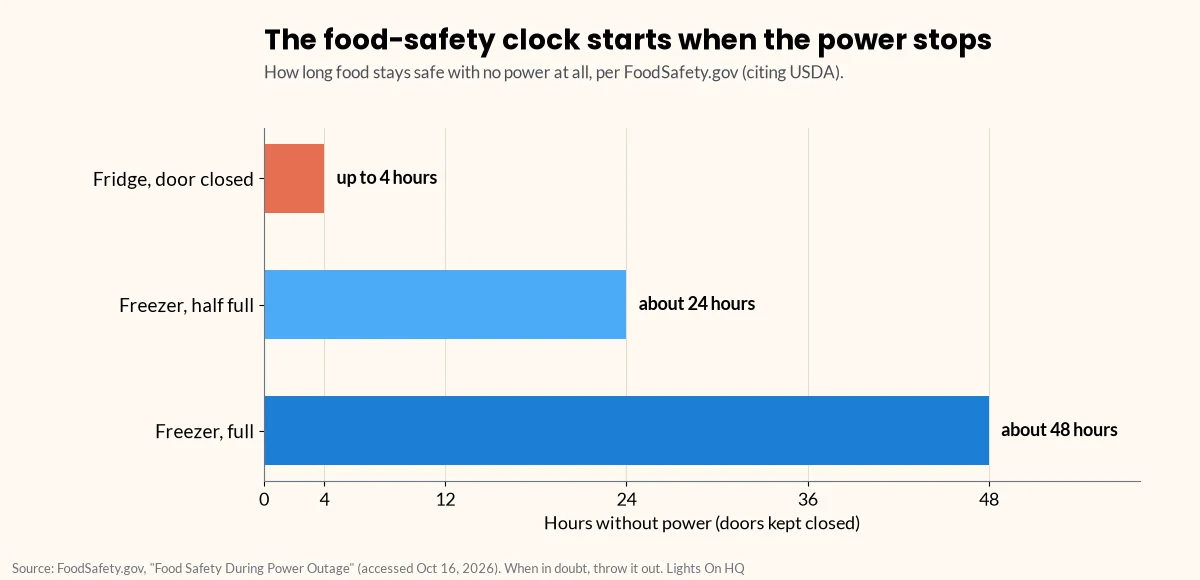
- The clock is ticking: a closed fridge keeps food safe for up to 4 hours without power; a full freezer about 48 hours (24 if half full) (FoodSafety.gov).
- Size by energy, not nameplate: use the kWh/year on the yellow EnergyGuide label. Example: 500 kWh/yr ≈ 1,370 Wh/day.
- Check surge: fridge compressors need a startup spike. Pick a unit with a published surge rating, and ignore “boost” modes.
- Our spec picks (~2 kWh): Anker SOLIX C2000 Gen 2 (4,000 W peak, 10 ms UPS), EcoFlow DELTA 2 Max (4,800 W surge, expandable), BLUETTI AC200L (7,200 W surge per BLUETTI, expandable to 8,192 Wh).
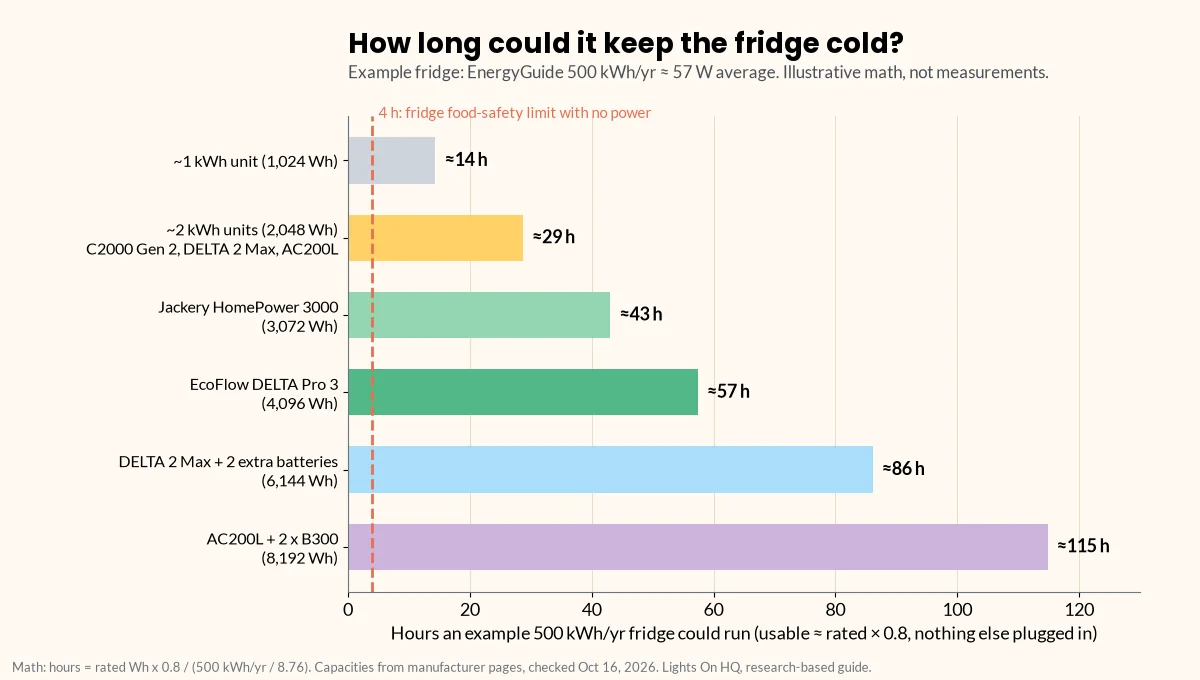
- Example fridge (500 kWh/yr): about 29 hours on a ~2 kWh unit, 43 hours on 3 kWh (our 0.8 planning rule).
Every outage has the same plot twist. First 10 minutes: “This is kind of cozy!” Hour two: someone opens the fridge “just to check,” and the whole family gasps like it’s a horror movie. Hour four: you’re Googling “is mayo still safe.”
A power station that can keep your fridge humming turns that drama into a non-event. Here’s how to pick one that will actually start your fridge and keep it running long enough to matter.
Step 1: Know your deadline
According to FoodSafety.gov (citing USDA), your refrigerator keeps food safe for up to 4 hours during an outage if you keep the door closed. Perishables like meat, poultry, fish, eggs and leftovers should be thrown out after 4 hours without power. A full freezer holds a safe temperature for about 48 hours, or 24 hours if half full and the door stays shut (FoodSafety.gov).
⚡ Quick take
Even a modest power station buys you time past that 4-hour line. The freezer is the patient one; the fridge is the drama queen. Keep both doors closed and let the battery do its thing.
Step 2: Figure out how much energy your fridge uses
Skip the nameplate watts. The compressor cycles on and off, so nameplate watts overstate daily use. Instead:
- Find the yellow EnergyGuide label (or your model’s spec sheet) and read the kWh per year.
- Daily Wh = (kWh per year ÷ 365) × 1,000. Example: 500 kWh/yr ÷ 365 × 1,000 ≈ 1,370 Wh/day, or about 57 W on average.
- Most accurate: a plug-in watt meter for 24 hours.
Then add a margin for losses. Our planning rule is usable Wh ≈ rated Wh × 0.8 (a judgment call based on manufacturer runtime formulas such as BLUETTI’s). Full math: how long will a 2,000 Wh power station run a fridge?
Step 3: Make sure it can start the compressor
Fridges and freezers pull a short startup spike when the compressor kicks on, and that spike can be several times the running draw. Check your fridge’s manual or ask the manufacturer. Then:
- The station’s continuous AC output must exceed everything running at once.
- The station’s surge rating must cover the startup spike.
- Ignore “boost” figures. EcoFlow’s “X-Boost” and BLUETTI’s “Power Lifting” are for heating appliances. BLUETTI’s manuals say Power Lifting isn’t for motor or compressor loads. More: surge vs running watts.
The picks (by published specs)
All prices are brand-store prices on Oct 16, 2026. “Example fridge hours” uses a 500 kWh/yr fridge and our 0.8 rule. It’s illustrative, not a measurement.
| Model | Capacity | AC out / surge | UPS | Solar in | Weight | Price | Example fridge hours |
|---|---|---|---|---|---|---|---|
| Anker SOLIX C2000 Gen 2 | 2,048 Wh | 2,400 W / 4,000 W peak | 10 ms | 800 W | 41.7 lb | $999.99 | ~29 h |
| EcoFlow DELTA 2 Max | 2,048 Wh (to 6,144) | 2,400 W / 4,800 W | not listed | 1,000 W | 50 lb | $1,049 | ~29 h (~86 h max expanded) |
| BLUETTI AC200L | 2,048 Wh (to 8,192) | 2,400 W / 7,200 W† | ≤20 ms | 1,200 W | 62.4 lb | $899 | ~29 h (~115 h max expanded) |
| Jackery Explorer 2000 v2 | 2,042 Wh | 2,200 W / 4,400 W | <20 ms | 400 W | 39.5 lb | $899 (sold out) | ~29 h |
| BLUETTI Elite 200 V2 | 2,073.6 Wh | 2,600 W / not published for motors‡ | ≤15 ms | 1,000 W | 53.4 lb | $899 | ~29 h |
| Jackery HomePower 3000 | 3,072 Wh | 3,600 W / 7,200 W | ~20 ms | 1,000 W | 59.5 lb | $1,349 | ~43 h |
† BLUETTI’s AC200L product page lists 7,200 W surge; its user manual lists overload of 3,000–3,600 W for 5 seconds and over 3,600 W for 0.5 s. The two don’t match. Until BLUETTI clarifies, treat 7,200 W as the brand’s headline figure, not a guaranteed compressor-start rating. ‡ BLUETTI’s 3,900 W figure for the Elite 200 V2 is Power Lifting for resistive loads only. We didn’t find a separate motor-surge rating. Ask BLUETTI before relying on it for a fridge.
Sources: Anker C2000 Gen 2, EcoFlow DELTA 2 Max, BLUETTI AC200L and manual, Jackery Explorer 2000 v2, BLUETTI Elite 200 V2, Jackery HomePower 3000.
Best all-rounder for a fridge: Anker SOLIX C2000 Gen 2
A published 4,000 W peak figure, a 10 ms UPS (so the fridge just keeps going when the grid drops) and a manageable 41.7 lb. Its 800 W solar input is mid-pack. Check C2000 Gen 2 price at Anker SOLIX
Best for long outages with solar: EcoFlow DELTA 2 Max or BLUETTI AC200L
Both start at 2,048 Wh and expand: the DELTA 2 Max to 6,144 Wh, the AC200L to 8,192 Wh. The AC200L takes 1,200 W of solar; the DELTA 2 Max takes 1,000 W. Downsides: the AC200L is the heaviest here at 62.4 lb, and EcoFlow doesn’t list a UPS switchover time for the DELTA 2 Max. Check DELTA 2 Max price at EcoFlow · Check AC200L price at BLUETTI
Best value for a fridge and more: Jackery HomePower 3000
About $0.44 per Wh on our check date, with 3,072 Wh and a 7,200 W surge rating. It’s 120 V only and 59.5 lb. Check HomePower 3000 price at Jackery
⚡ Quick take
For a fridge, surge rating + UPS matter as much as capacity. A unit that can’t start the compressor is just a very expensive doorstop.
Fridge outage tips that don’t need a battery
- Keep the doors closed. That’s the single biggest thing FoodSafety.gov recommends.
- When in doubt, throw it out, and never taste food to check if it’s safe (FoodSafety.gov).
- Plug the fridge straight into the power station with the fridge’s own cord (or a properly rated cord). Don’t connect the station to a wall outlet or your home wiring.
⚠️ Safety notes
- No backfeeding. Never plug a power station into a wall outlet to feed your house circuits; the CPSC warns this endangers utility workers and neighbors (CPSC, PDF). For hard-wired circuits, hire a licensed electrician to install a transfer switch or inlet. Transfer switch explainer
- Food safety beats battery math. If the fridge was above 40°F for more than 2 hours, follow FoodSafety.gov’s chart, whatever the battery says.
Related
- How long will a 2,000 Wh power station run a fridge?
- Best portable power station for home backup
- Runtime calculator
- DELTA 2 Max vs Explorer 2000 v2
- All use-case guides (hub)
Last checked: October 16, 2026. Found an error? Tell us.